What a medical biller does
A medical biller turns completed patient visits into clean insurance claims, posts payments from health plans, and makes sure patients are billed only what their benefits require.
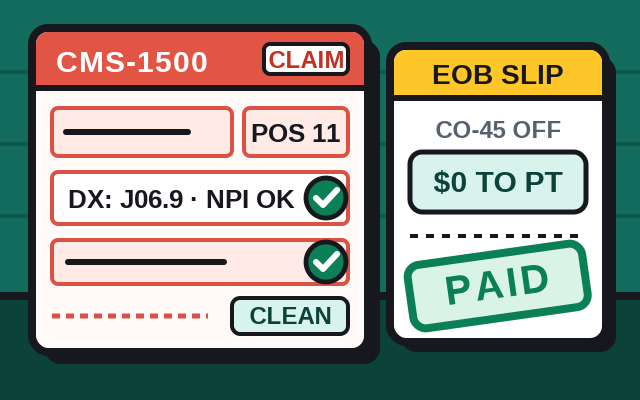
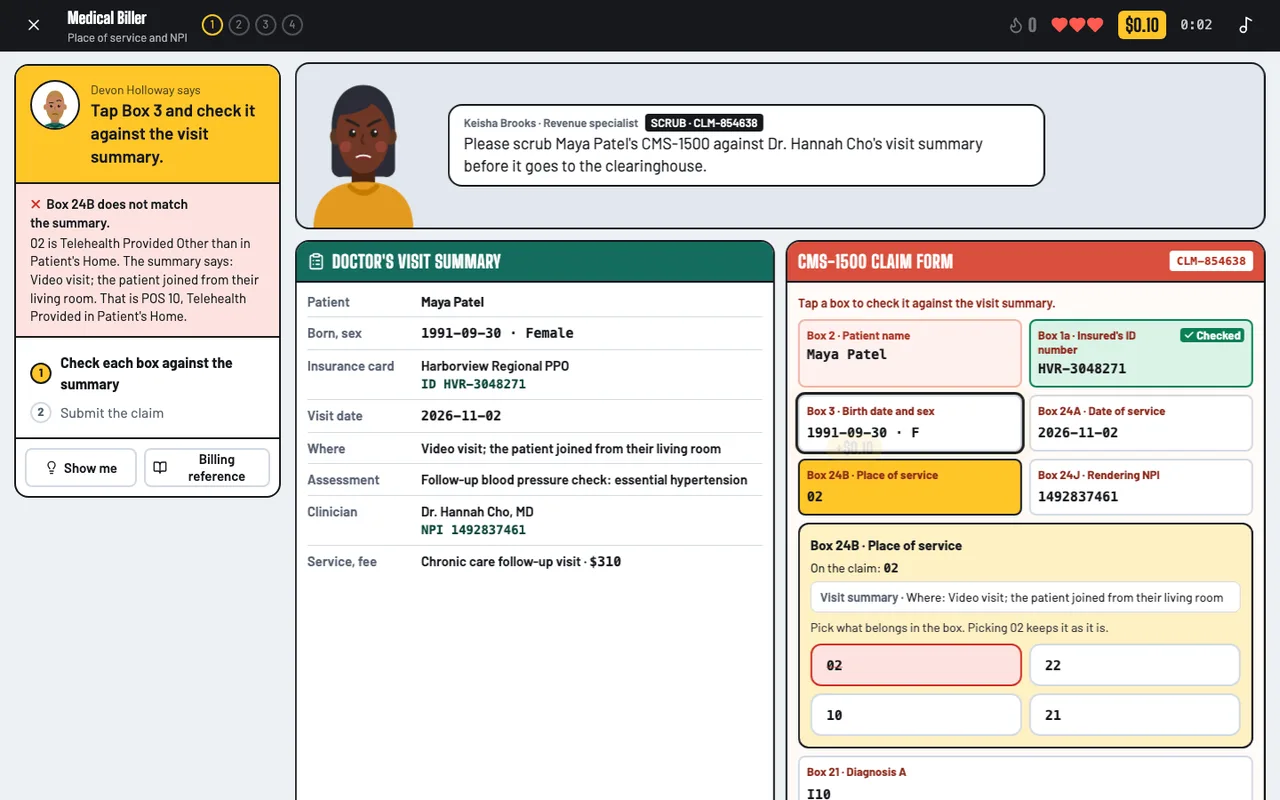
Before a claim leaves the clinic, billers scrub CMS-1500 fields against the visit chart: member IDs, dates of service, CMS Place of Service codes, ICD-10-CM diagnoses, and 10-digit Rendering Provider NPIs. After the payer responds with an Explanation of Benefits (EOB) or electronic remittance, billers post contractual write-offs, compute patient balances, and work any CARC denial codes.
- Scrub draft CMS-1500 claims against clinical visit summaries
- Verify CMS Place of Service codes (office, urgent care, ER, inpatient, telehealth)
- Post EOB payments, CO-45 contractual write-offs and patient balances
- Work CARC denial codes through corrected claims, appeals or contractual adjustments
- Answer patient billing questions clearly and protect health privacy under HIPAA
What a shift at a billing desk is like
Financial clerks, billing clerks among them, usually work in offices such as medical practices, and most work full time, according to the Bureau of Labor Statistics. The work comes in batches: claims to scrub before they go out, payments to post from incoming EOBs, and denied or aging claims to follow up.
Because every dollar has to reconcile, the work rewards calm checking over rushing. Catching a wrong Place of Service code or a missing NPI digit before the claim goes out saves a rejection and a resubmission, and knowing when a CO adjustment must be written off protects both the patient and the practice.
Skills that make a strong medical biller
Attention to small details comes first: one transposed digit in Box 1a or a telehealth visit marked as an office visit can stop an otherwise valid claim. You also need comfortable EOB math so deductible, coinsurance, copay, and out-of-pocket maximum rules feel automatic.
Just as important is compliance judgment — knowing the line between valid patient responsibility (PR) and contractual obligations (CO) that must never be billed to the patient.
- Spotting mismatches between visit notes and CMS-1500 claim boxes
- Calculating deductible, coinsurance, copay and out-of-pocket caps from Allowed Amounts
- Reading CARC group codes (CO, PR, OA) and choosing the right next step on a denial
- Applying HIPAA Minimum Necessary rules when sending records for appeals
How to get started in medical billing
According to O*NET OnLine for billing and posting clerks (43-3021.00), the work usually needs a high school diploma or GED, with training on the job. A short medical billing certificate or a credential such as NHA's CBCS is another way to show what you know; the CBCS also tests procedure coding, which this game does not.
Knowing how you would handle a CO-45 write-off, a CO-16 or OA-18 denial, and how you would explain a deductible on an EOB to a confused patient gives you concrete answers to bring to an interview.
Pay and job outlook
According to O*NET OnLine (43-3021.00), the 2025 median pay for billing and posting clerks was $48,500 a year, or $23.32 an hour, across 418,000 jobs nationwide.
Employment from 2025 to 2035 is projected to show little or no change, yet there are still about 37,000 openings a year. The Bureau of Labor Statistics expects openings for financial clerks to come from replacing workers who move to other jobs or retire.