Skip to content

Line cook simulator game: kitchen and food safety

Work a commercial kitchen line: probe safe cooking temperatures, stock the walk-in cooler and stop allergen cross-contact.

A free line cook simulator game online: 8 shifts that start easy, a new one every day, and an endless one. No download, no sign-up, on a phone or a computer.

Clock in: first shift

4 minutes. Every step explained. No sign-up.

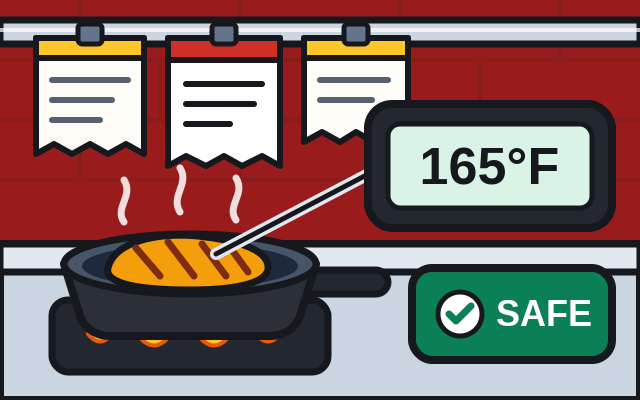
Commercial kitchen grill line with hanging order tickets, a sizzling cast-iron skillet, a digital probe thermometer reading 165 degrees Fahrenheit, and a green safe badge
I'm Chef Hector Navarro. I'll show you how it's done.

Your schedule

8 shifts. Each adds one skill and keeps the old ones. Start anywhere; the marked one is next for you.

What you will do

A shift in the line cook simulator
  • Cook & probe the grill

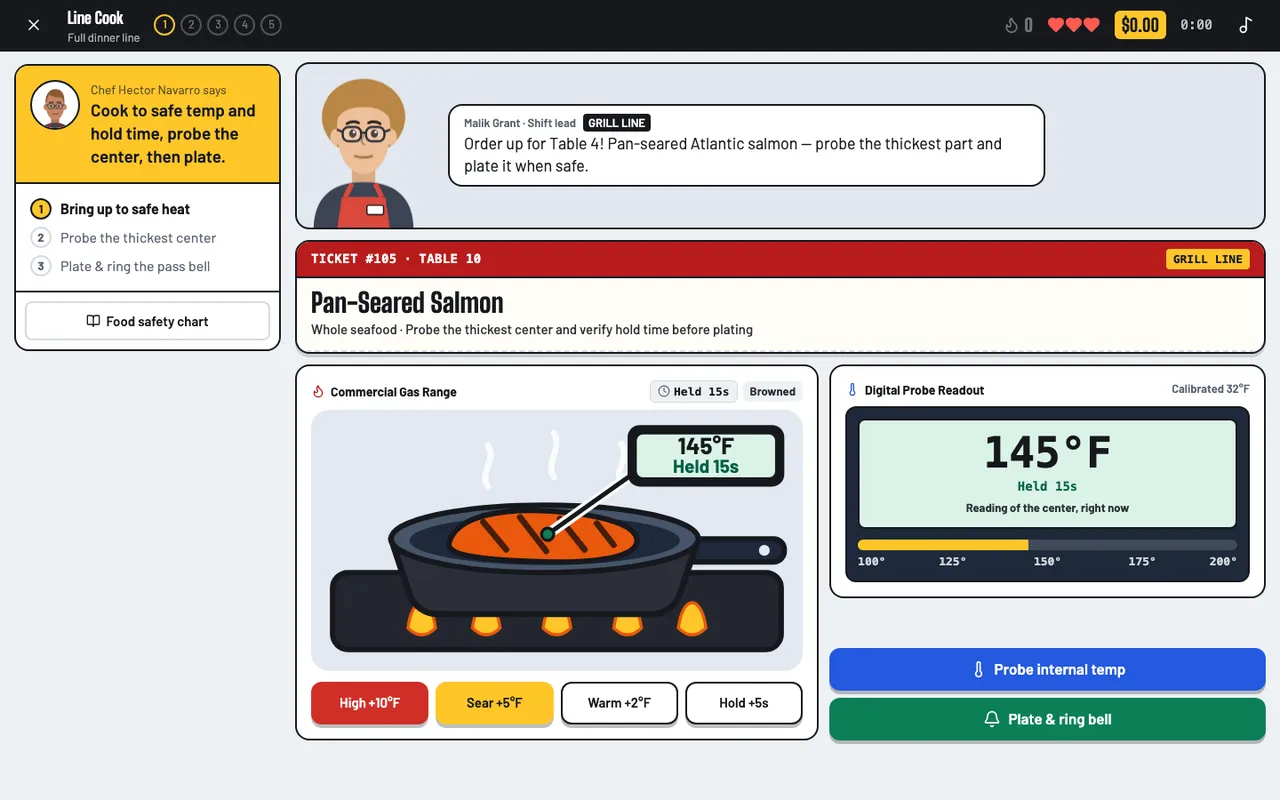
    Bring salmon (145°F), smash burgers (155°F) and chicken (165°F) to safe FDA Food Code temps without burning them.

  • Stock & audit the walk-in

    Stack a 5-shelf walk-in cooler top-to-bottom and catch raw poultry over greens or expired Day 8 pans.

  • Log holding & cooling

    Spot Danger Zone pans (41°F–135°F) and check two-stage cooling: 135°F to 70°F in 2 hours, 41°F by hour 6.

  • Handle Big 9 allergy tickets

    Prevent cross-contact on sesame, shellfish, dairy, peanut and wheat orders with clean pans, tools and gloves.

Line Cook practice tools

Drills, calculators and reference lists for the skills of this job.

What a line cook does

A restaurant line cook prepares and finishes menu dishes at a specific station — grill, sauté, fry, cold pantry or expediter pass — while keeping every plate safe, consistent and on time.

Behind the sizzling pans, food safety rules run the whole shift. Line cooks probe internal cooking temperatures, log hot and cold holding wells, rotate 7-day date marks in the walk-in cooler, cool hot batches in two stages, and prevent Big 9 food allergen cross-contact during dinner rush.

  • Cook meat, poultry, seafood, eggs and hot sides to exact FDA Food Code internal temperatures
  • Stock and audit the walk-in cooler top to bottom so raw juices never drip onto ready-to-eat food
  • Monitor the 41°F–135°F Danger Zone, two-stage cooling logs and 7-day ready-to-eat date labels
  • Prepare allergy tickets on sanitized surfaces with clean pans, fresh utensils and fresh gloves
  • Communicate clearly with the expediter, servers and sous chef during busy services

What a kitchen shift is like

Most shifts start before the dining room opens: checking walk-in temperatures, verifying date tape on prepped hotel pans, calibrating probe thermometers and setting up your station with clean sanitizing buckets and backup mise en place.

Once service starts, tickets clip onto the rail in waves. Lunch and weekend dinner rushes reward steady habits over frantic speed — probing the thickest center of a chicken breast takes two seconds and protects every guest in the room.

Food safety habits that make a standout cook

Chefs notice cooks who stay calm and follow food safety rules even when ten tickets hang on the rail. Knowing 165°F, 155°F, 145°F, 135°F and 41°F by heart means you never hesitate with the thermometer.

Just as important is respecting the FDA Big 9 allergens — milk, eggs, fish, crustacean shellfish, tree nuts, peanuts, wheat, soybeans and sesame. Never scraping cheese off a burger or reusing shrimp fryer oil protects guests from life-threatening reactions.

  • Probing every thick protein instead of guessing by color or grill marks
  • Keeping raw poultry on the bottom walk-in shelf and ready-to-eat pans on top
  • Cooling large hot batches in shallow pans or ice baths to beat the 2-hour 70°F mark
  • Washing hands properly for 20 seconds and changing gloves between raw meat and ready-to-eat tasks

How to get hired as a line cook

According to O*NET OnLine (restaurant cooks, 35-2014.00), the job usually requires a high school diploma or GED, and training ranges from a few days to one year on the job. Some states and counties also require a food handler card; ask your local health department what applies where you work.

Showing up in slip-resistant shoes, knowing basic cooking temperatures and walk-in cooler order, and proving you take allergy tickets seriously will help you stand out in a working interview or stage shift.

What restaurant cooks earn and job outlook

In 2025, median pay for restaurant cooks was $37,390 a year, or $17.98 an hour, according to O*NET OnLine (35-2014.00). Nationwide employment stood at 1,417,500 jobs.

Projected job growth from 2025 to 2035 is much faster than average (7% or higher), with about 218,600 openings a year across restaurants, hotels and kitchens.
Line Cook simulator: questions

Is this line cook simulator free to play?

Yes. You can play all 8 kitchen shifts, the daily service, endless rush and all three food safety drills free in your browser on a phone or computer with no account or download.

Does this kitchen game use real FDA Food Code temperatures?

Yes. Every cooking temperature (165°F instantaneous poultry, 165°F for 15 seconds reheating TCS leftovers within 2 hours, 155°F for 17 seconds or 158°F instantaneous ground meats, 145°F whole cuts and seafood for 15 seconds, 135°F hot holding and 41°F cold holding), two-stage cooling window, 7-day date mark and Big 9 allergen list follows the FDA Food Code 2022.

Can this help me study for a food handler card or ServSafe-style test?

It gives you hands-on practice with the FDA Food Code numbers and decisions a line cook uses every shift, plus a standalone 15-question practice test. It is independent practice and not affiliated with ServSafe or the National Restaurant Association.

Why does ground beef cook to 155°F here instead of 160°F?

Commercial FDA Food Code §3-401.11 allows ground meat at 155°F held for 17 seconds or 158°F instantaneous (<1 second). The home chart at FoodSafety.gov, written for home cooks, lists 160°F for ground meat, with no hold time.

Why does raw poultry always go on the bottom shelf of a walk-in cooler?

Walk-in shelves are ordered top to bottom by minimum cooking temperature. Ready-to-eat food sits on top because it will not be cooked again, while raw poultry requires 165°F and must stay on the bottom shelf so its juices can never drip onto any other food.

Can frying oil or scraping food remove a food allergen?

No. Allergen proteins survive normal cooking and frying temperatures, and scraping cheese or picking nuts off a dish leaves residue behind. Always remake contaminated dishes with clean hands, fresh gloves and freshly sanitized cookware.

Where this comes from

Last changed . Rules change, and states and employers add their own: at work, follow theirs. Found a mistake? How we check, and how to tell us.

Try another job