Free food handler practice test: ServSafe-style
Prepare for your kitchen card with this free food handler practice test. Independent ServSafe-style questions cover FDA Food Code temps, cooling, cooler order and Big 9 allergens.
Under the FDA Food Code 2022, what is the minimum internal cooking temperature for whole or ground poultry?
For practice only. Not affiliated with ServSafe or the National Restaurant Association. Follow your local health department code at work.
Use it on a real shift
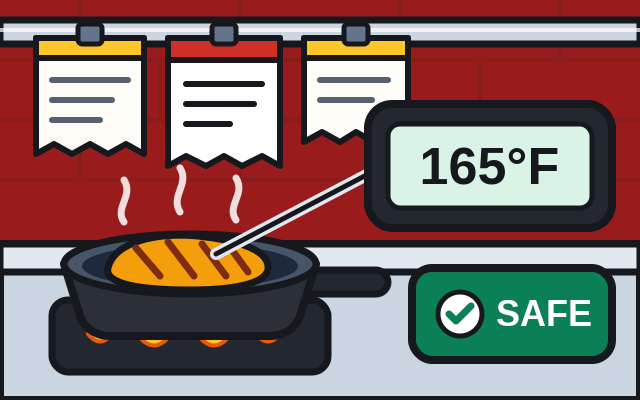
Line Cook simulator: Work a commercial kitchen line: probe safe cooking temperatures, stock the walk-in cooler and stop allergen cross-contact.
Food handler exam study guide (FDA Food Code 2022)
Independent review of four food safety topics of the FDA Food Code 2022 that the practice test asks about.
1. Cooking & reheating temperatures
- 165°F instantaneous (<1 sec): Whole or ground poultry, stuffed meats/pasta, and stuffing containing meat. Reheating TCS leftovers for hot holding requires 165°F for 15 seconds within 2 hours (§3-403.11).
- 155°F for 17 seconds (or 158°F instantaneous): Ground beef, ground pork, sausage, mechanically tenderized meats, and hot-held shell eggs (§3-401.11).
- 145°F for 15 seconds: Whole seafood, whole steaks and chops (beef, pork, veal, lamb), and eggs cooked for immediate service.
- 135°F: Plant foods (rice, beans, vegetables) cooked for hot holding and commercially processed RTE food heated for hot holding.
2. Two-stage cooling & date marking
- Danger Zone: 41°F to 135°F. Cold hold at or below 41°F; hot hold at or above 135°F.
- Two-stage cooling: Drop hot TCS food from 135°F to 70°F within 2 hours, then to 41°F by hour 6 in total (time saved in the first stage carries over).
- Missed a mark? Still above 70°F at the 2-hour check, or above 41°F at the 6-hour check: reheat to 165°F for 15 seconds and cool it again a faster way, or throw it out. Found still above 70°F more than 2 hours in, or above 41°F more than 6 hours in: throw it out (FDA Food Code Annex 5).
- 7-day date marking: Ready-to-eat TCS food held at 41°F or lower lasts at most 7 days (prep day counts as Day 1).
3. Cross-contamination & handwashing
- Prevent cross-contamination by storing walk-in shelves top-to-bottom by cooking temp: Ready-to-eat → Seafood → Whole beef/pork → Ground meat → Poultry on the bottom.
- Wash hands in a dedicated handwashing sink for at least 20 seconds total (10–15 seconds of vigorous soap scrubbing) before starting work, after raw meat, after touching your face or phone, and before putting on fresh gloves.
- Never handle ready-to-eat food with bare hands — use single-use gloves, tongs, deli tissue, or clean utensils.
4. FDA Big 9 major food allergens
The FDA names nine major food allergens, sesame the ninth since 2023. Cross-contact cannot be scraped off, wiped off or burned off in fryer oil: prepare allergy orders with clean hands, fresh gloves, sanitized pans and clean utensils.
Questions people ask
Is this an official ServSafe exam?
No. This is an independent food handler practice test built from public FDA Food Code 2022 rules, not affiliated with ServSafe or the National Restaurant Association.
What score passes this practice test?
This practice test counts 75% (12 of 15) as a pass. Each food handler exam sets its own pass mark, so check the one for your card, and aim higher in practice.
What are the FDA Big 9 major food allergens?
Milk, eggs, fish, crustacean shellfish, tree nuts, peanuts, wheat, soybeans and sesame. Sesame became the 9th major allergen under federal law.
What is the two-stage cooling rule?
Cooked TCS food must cool from 135°F to 70°F within 2 hours (Stage 1), and to 41°F within 6 hours in total (Stage 2), so time saved in Stage 1 carries over (FDA Food Code 3-501.14). Food that misses 70°F at the 2-hour check, or 41°F at the 6-hour check, can be reheated to 165°F for 15 seconds and cooled again a faster way; found still above 70°F more than 2 hours in, or above 41°F more than 6 hours in, it is thrown out (Food Code Annex 5).
Where this comes from
Last changed . Rules change, and states and employers add their own: at work, follow theirs. Found a mistake? How we check, and how to tell us.