What a notary public and loan signing agent does
A notary public is an officer commissioned by a state to take acknowledgments, give oaths and keep a record of each act. The notary confirms who is signing and that they appear in person. Notaries who work mortgage and real estate closings are often called loan signing agents: they take borrowers through deeds, Closing Disclosures and sworn affidavits so the lender's packet comes back complete.
The stamp itself takes two seconds. The job is everything before it: checking expiration dates and photos on IDs, reading whether the certificate is an acknowledgment or a jurat, giving oaths, catching blank lines or missing initials, filling in the record book and knowing when not to notarize.
- Check personal appearance and identity (an ID, or a credible witness)
- Tell an acknowledgment certificate from a jurat, which needs an oath and a signature in front of you
- Read loan packets for blank lines, missing initials, wrong dates and venue errors
- Record every act in the notary's record book
- Stay impartial: no notarizing for yourself and no legal or loan advice
What a closing shift feels like
Early in the month, appointments move at an unhurried pace: a deed at 10 a.m., a power of attorney after lunch, an occupancy affidavit before four. Near the end of the month, closings stack up back to back.
Signers sometimes arrive flustered, with an affidavit signed at home, a license that just expired or questions about their rate. A steady signing agent slows the table down without sounding cold, says what a notary can and cannot do, and sends back a packet that passes title review the first time.
Core rules at a Texas notary desk
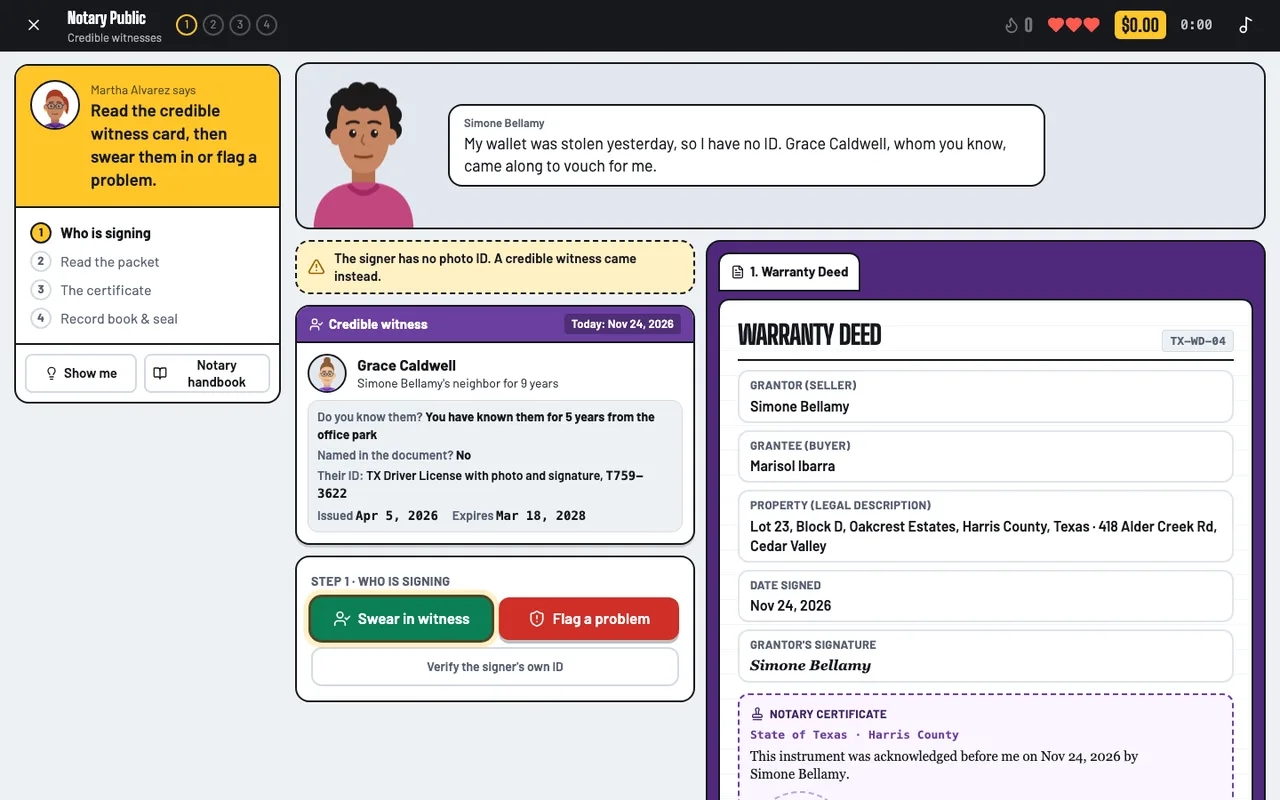
First is personal appearance: the signer is in front of you (or in an online session where the law allows it). No spouse, assistant or coworker can bring in someone else's signed deed and ID. Identity comes from a current government ID with photo and signature, or from a credible witness (Tex. Civ. Prac. & Rem. Code § 121.005).
Second is the certificate: an acknowledgment may be signed beforehand and needs no oath; a jurat needs an oath or affirmation and a signature made in front of you. You complete the certificate printed on the document and never choose one for the signer (Texas Secretary of State). Third is impartiality: you do not notarize a document you gain from, and you give no legal advice (Tex. Gov't Code § 406.016(d)).
- Check the ID photo, name and expiration date
- Give the oath or affirmation on every jurat
- Give no advice on loans, taxes or legal rights
- At Cedar Creek, never stamp a document with a blank line (California makes it law)
How to become a notary public
Each state sets its own requirements through its Secretary of State or a similar office. In Texas an applicant is a resident at least 18 years old with no felony conviction, takes the education course, posts a $10,000 bond and keeps a seal and a record book; California applicants also pass a written exam. Check your own state's office for the steps.
Notaries who want to work mortgage closings usually take extra loan signing training and learn how title companies read Closing Disclosures, deeds and rescission notices.
Pay and job outlook
The U.S. Bureau of Labor Statistics does not track notaries public as a separate occupation because many people hold a notary commission alongside another office, bank, title or real estate role. For closing-desk work, loan interviewers and clerks (O*NET 43-4131) is the closest official benchmark.
In 2025, loan interviewers and clerks earned a median of $50,020 a year, or $24.05 an hour, across 169,100 U.S. jobs. Employment is projected to decline (-1% or lower) from 2025 to 2035, yet the occupation still has about 10,500 openings a year as workers move on or retire. States cap what a notary may charge for each act.