What an airport security officer does
At U.S. airports the job is called transportation security officer, or TSO, and the agency is the Transportation Security Administration (TSA). Officers make sure that what should not be on a plane does not get on one, without turning the hall into a traffic jam.
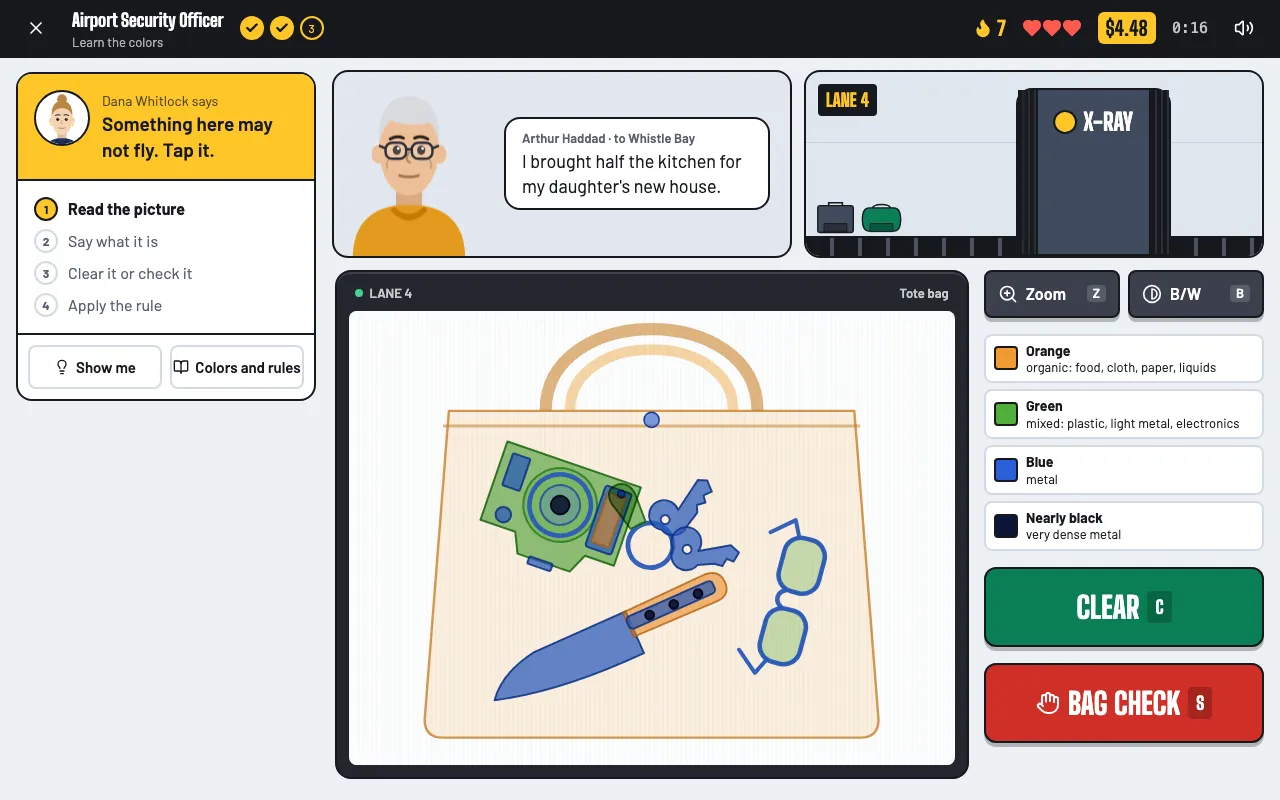
The game puts you at two of the places an officer works: the X-ray lane with its bag check table, and the document desk at the front. At many airports a machine reads the ID and finds the flight by itself; here the boarding pass is still paper.
- Check tickets, and whether the traveler must show photo ID
- Watch X-ray images of bags and decide what needs a closer look
- Search bags by hand and take out items that are not allowed
- Test bags with a swab or a machine
- Do pat-downs or wand searches when a machine alarms
- Answer travelers' questions and keep the line moving
What you need to be good at
Above all, looking. A bag is a pile of overlapping shapes, and you have seconds to take it apart in your head. People who do it well use the same order every time: outline first, color second, then ask what does not belong.
The other half is people. You tell somebody that their grandfather's pocket knife cannot come along, and you stay kind about it all day. The job is also physical: TSA lists lifting bags of up to 50 pounds.
A shift on the checkpoint
A checkpoint has several posts: the document desk, the X-ray monitor, the bag check table, the place where people walk through. The line does not stop at five o'clock: TSA asks applicants to be able to work odd shifts and overtime.
Most bags are fine, and saying so quickly is as much the job as stopping the others. That is why a false alarm breaks your streak in this game just as a miss does.
How to get hired
TSA asks that you are a U.S. citizen or national, at least 18, with a high school diploma or GED, registered for Selective Service if that applies to you, and able to pass a drug screening, a medical evaluation and a background investigation.
If you meet the basic requirements you may be invited to a computer-based test. In TSA's words it evaluates image interpretation aptitude: looking at pictures and judging what is in them. You take it at a test center, and you have 21 calendar days from the invitation to schedule and finish it, or the application closes.
After the test come a tentative offer, a panel interview at the airport, the medical evaluation (color vision, distance vision and hearing included), the drug test and the background check. Candidates who pass wait in a ready pool until the airport has a place.
Pay and outlook
The median pay of transportation security screeners in the United States was $66,770 a year in 2025, or $32.10 an hour. There were 53,500 of them.
The number of jobs is projected to fall by 4 percent from 2025 to 2035. There are still about 4,500 openings a year in that time, because openings include replacing people who leave.