Skip to content

EMT simulator game: scene triage and vitals

Run Medic 4: size up scene safety, treat life threats in the right order, read vital signs and snap START triage tags.

A free EMT simulator game online: 8 shifts that start easy, a new one every day, and an endless one. No download, no sign-up, on a phone or a computer.

Clock in: first shift

4 minutes. Every step explained. No sign-up.

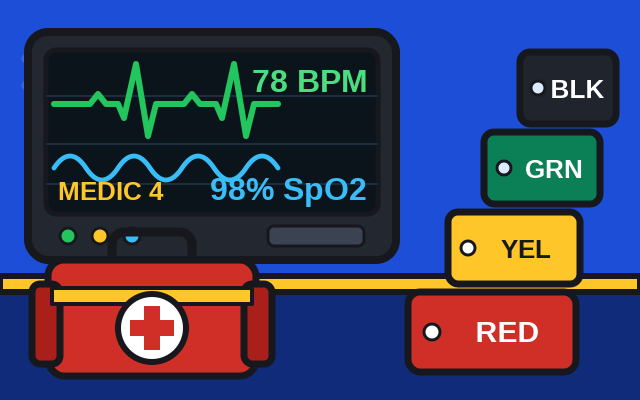
EMS Medic 4 station: a dark patient vitals monitor showing an ECG wave and 98 percent SpO2, a red trauma bag with a white cross, and four START triage tags
I'm Capt. Naomi Brooks. I'll show you how it's done.

Your schedule

8 shifts. Each adds one skill and keeps the old ones. Start anywhere; the marked one is next for you.

What you will do

A shift in the EMT simulator
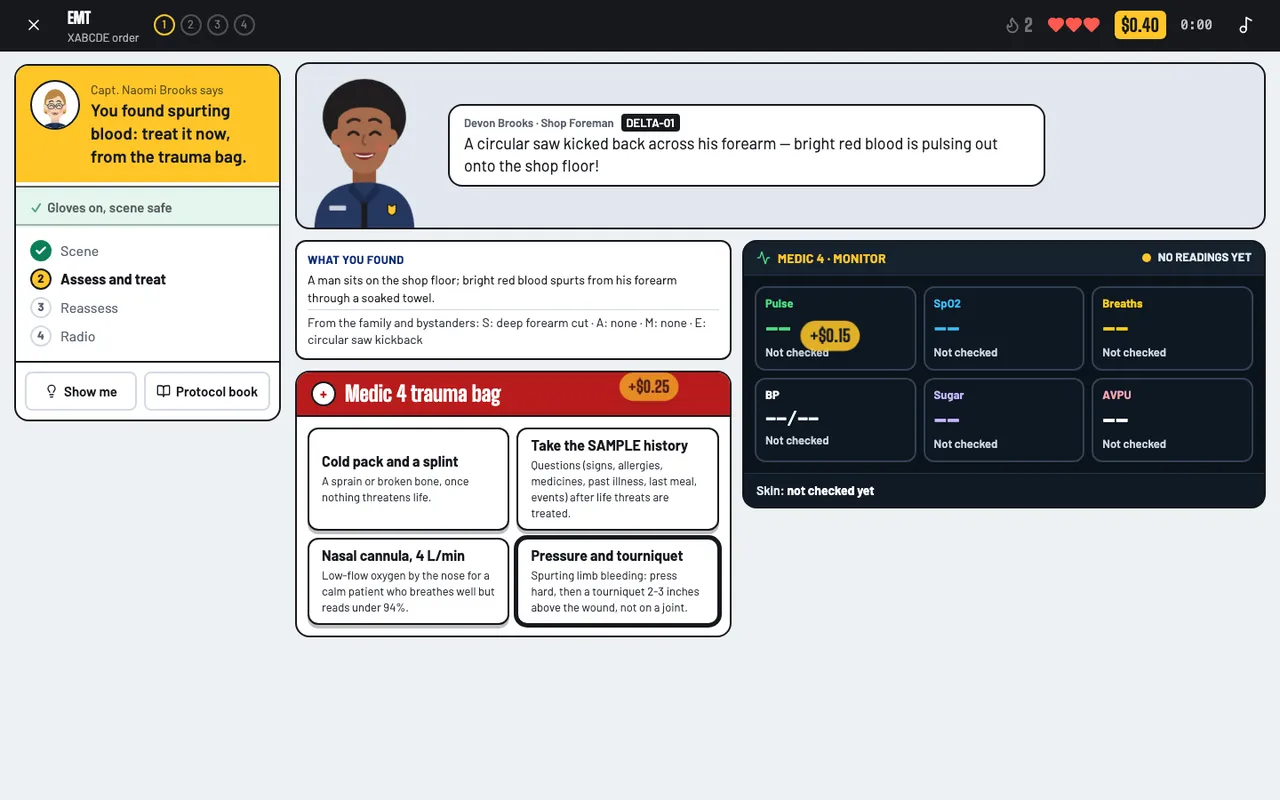
  • Size up gloves and scene safety

    Put on gloves first and spot live power lines, chemical clouds, weapons or highway traffic before stepping in.

  • Treat life threats as you find them

    Stop spurting blood, open airways (a jaw thrust after a fall), and give oxygen or bag-valve-mask breaths before vital signs.

  • Read the Medic 4 monitor

    Catch a fast or slow pulse, SpO2 under 94%, a systolic under 90 and low blood sugar.

  • Snap START mass-casualty triage tags

    Apply RPM 30-2-Can Do to sort casualties into Red, Yellow, Green or Black and radio a clean ER report.

EMT practice tools

Drills, calculators and reference lists for the skills of this job.

What an EMT does on a real shift

Emergency medical technicians respond to 911 calls and transfers between hospitals, assess sick or injured patients at the scene, provide basic life support (BLS), and give clear reports to emergency department nurses and doctors.

Every call follows a set order so that nothing critical is missed under stress: put on body substance isolation (BSI) gloves and eye protection, make sure the scene is safe, find and treat life threats in the primary survey as you find them, then take vital signs and a history, and recheck the patient all the way to the hospital.

  • Size up scene dangers and stay back for police, fire, the power company or hazmat when needed
  • Control major bleeding, open airways, give oxygen and breathe for patients with a bag-valve-mask (BVM)
  • Measure and read pulse, breathing rate, blood pressure, SpO2 (oxygen in the blood) and blood sugar
  • Give a short list of medicines under medical direction (oxygen, oral glucose, aspirin, epinephrine, naloxone)
  • Sort multi-patient incidents with START triage and give short radio reports to the hospital

EMT vs paramedic: scope of practice

New students often mix up EMTs and paramedics because both crew ambulances. An EMT works on fast assessment, bleeding control, airways without tubes, oxygen, CPR and the AED, splinting, a short list of medicines, and recording and sending a 12-lead ECG.

A paramedic trains much longer and provides advanced life support (ALS): breathing tubes, IV lines, reading 12-lead ECGs and IV medicines. Good EMTs know their exact scope and call for paramedics early when a patient needs more.

Core skills every EMT practices

Calm order matters more than speed. Asking history questions while blood spurts from an arm, or squeezing oral glucose into the mouth of someone who cannot swallow, can harm a patient in seconds.

The eight shifts on Medic 4 drill those instincts: scene safety, the order of the primary survey, reading vital signs, choosing an oxygen device, checking medicine limits, and tagging mass-casualty patients with START triage.

  • BSI and recognizing electrical, chemical, violent and traffic dangers
  • The primary survey in order: bleeding, airway, breathing, circulation, with a jaw thrust when the neck may be hurt
  • Adult vital signs and the signs of shock (systolic blood pressure under 90)
  • START adult triage (RPM: 30 - 2 - Can Do) and short SAMPLE and OPQRST radio reports

How to become a certified EMT

Every state requires EMTs to be licensed in the state where they work. You complete a state-approved EMT program, usually a postsecondary certificate from a community college or a technical school, then pass the National Registry (NREMT) certification exams, which most states require, or an equivalent state exam.

Programs usually ask for a high school diploma and CPR certification first, and states may set a minimum age or a background check for the license.

EMT pay and job outlook

According to O*NET OnLine (occupation 29-2042), median pay for emergency medical technicians was $44,470 a year, or $21.38 an hour, in 2025. Roughly 181,900 EMT jobs existed nationwide in 2025.

Employment is projected to grow faster than average (5% to 6%) from 2025 to 2035, producing about 13,800 job openings a year.
EMT simulator: questions

Is this EMT simulator game free to play?

Yes. All eight training shifts, the daily dispatch shift, the endless 911 shift, and all three study tools are free in your browser with no download and no account.

Is this simulator affiliated with NREMT or official EMS training?

No. Practice the Job is an independent practice game for learning and fun. It is not affiliated with NREMT and never replaces accredited EMT coursework, medical direction or real emergency care. In a real emergency call 911.

In what order does an EMT treat a patient?

Gloves and scene safety first. Then the primary survey: spurting blood, airway, breathing and circulation, each treated as soon as it is found. Vital signs and history come after: the NREMT skill sheets count a secondary exam before treating threats to airway, breathing and circulation as a critical error.

What is the difference between an EMT and a paramedic?

EMTs give basic life support (BLS): bleeding control, airways without tubes, oxygen, bag-valve-mask breaths, CPR and the AED, splinting and a short list of medicines. Paramedics train further for advanced life support (ALS), such as breathing tubes and IV drugs.

Why does scene safety always come before helping the patient?

If an EMT walks into a downed live power line, a chemical cloud, a weapon or a lane of moving traffic, the crew can be hurt or killed, turning one emergency into several and delaying care for everyone.

How does START mass-casualty triage work?

START sorts adult casualties with RPM (30 - 2 - Can Do): walking patients are Green; patients who do not breathe even after the airway is positioned once are Black; patients who breathe only once the airway is positioned, breathe over 30 a minute, have no radial pulse or a capillary refill over 2 seconds, or do not obey commands are Red; everyone else who cannot walk is Yellow.

What are the normal adult vital signs practiced in this game?

From Arizona's EMS guidelines: pulse 60-100 a minute, breathing 12-20 a minute, oxygen given to keep SpO2 at 94% or more, a systolic blood pressure under 90 counted as low, and blood sugar under 60 with symptoms treated. The CDC calls blood sugar under 70 mg/dL low.

Try another job