Skip to content

Librarian game simulator: shelving and desk shifts

Run a public library desk: shelve Dewey Decimal call numbers, scan book returns, guide patrons and protect reading privacy.

A free librarian simulator game online: 8 shifts that start easy, a new one every day, and an endless one. No download, no sign-up, on a phone or a computer.

Clock in: first shift

4 minutes. Every step explained. No sign-up.

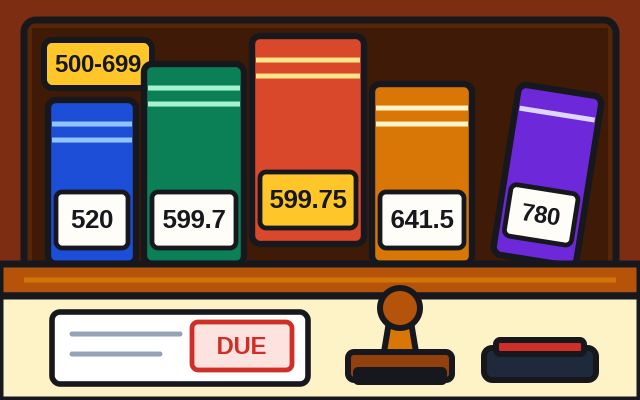
A public library shelf with colorful books labeled 520, 599.7, 599.75 and 641.5 above a wooden circulation desk with a date stamper
I'm Evelyn Cho. I'll show you how it's done.

Your schedule

8 shifts. Each adds one skill and keeps the old ones. Start anywhere; the marked one is next for you.

What you will do

A shift in the librarian simulator
  • Shelve Dewey & fiction carts

    Slide colorful spines into exact call-number order: tricky decimals, 3-letter author codes, and fiction titles ignoring A, An, and The.

  • Scan & sort book returns

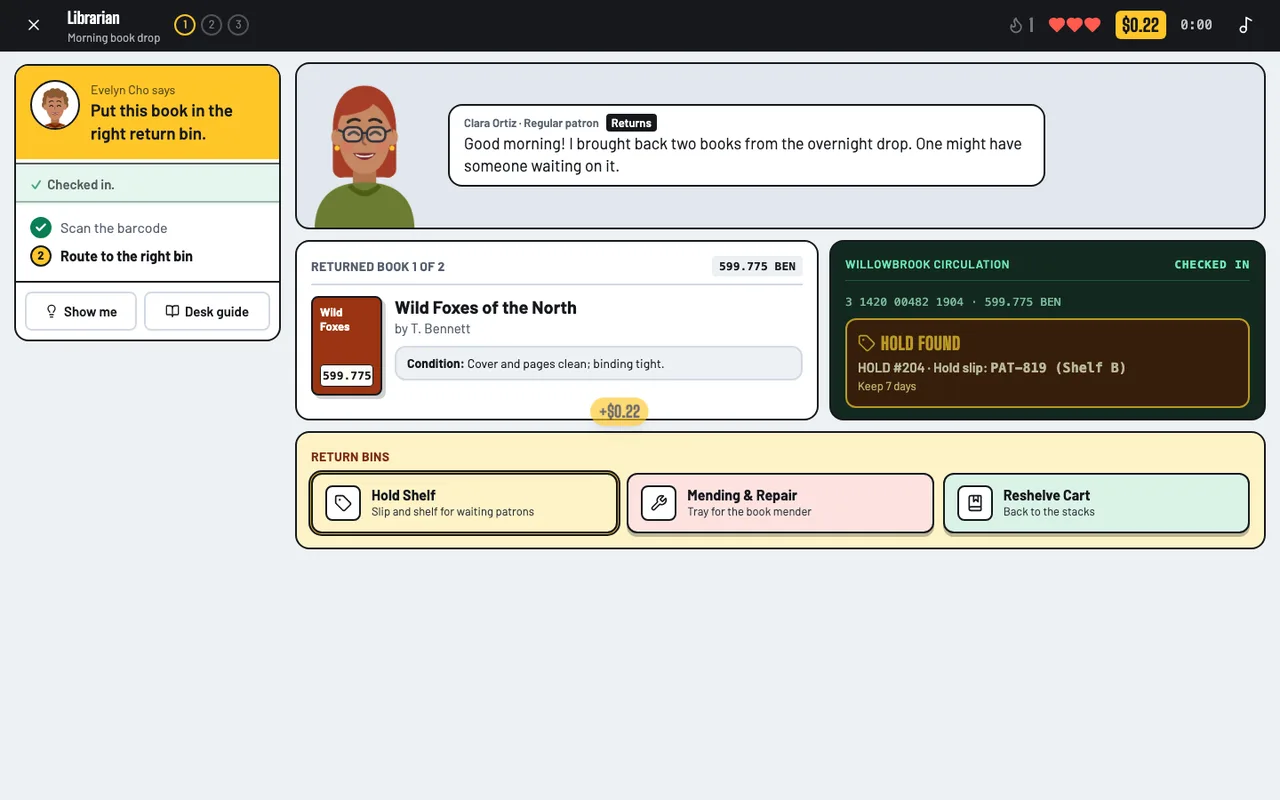
    Check in dropped books, send holds to the Hold Shelf, and tell real damage from normal wear before anything goes back to the stacks.

  • Guide patrons from 000 to 900

    Point readers asking for astronomy, Italian cooking, Spanish grammar, or history straight to the right Dewey wing.

  • Guard patron privacy

    Keep borrowing and hold records confidential while helping patrons with their own accounts, holds and catalog questions.

Librarian practice tools

Drills, calculators and reference lists for the skills of this job.

What librarians and library clerks actually do

Walk into a public library and you see two closely linked roles working side by side. Librarians (O*NET 25-4022) oversee collections, answer research questions, run community programs, and set branch policies. Clerical library assistants and library clerks (O*NET 43-4121) run the front circulation desk: checking books in and out, filling holds, looking returned copies over for damage, and shelving carts into call-number order.

This simulator lets you practice the hands-on daily work both teams rely on: reading Dewey Decimal call numbers digit by digit, filing fiction by author and title, pointing patrons to the right 000-900 wing, and protecting reader privacy at the desk.

  • Scan returned books to clear patron accounts and spot active hold requests
  • Inspect bindings for water stains, ripped pages, or loose spines before reshelving
  • Shelve nonfiction in exact Dewey Decimal order, then by the 3-letter author code
  • File fiction alphabetically by author last name and title (ignoring leading A, An, and The)
  • Protect confidential borrowing and hold records

Why shelving order and privacy matter so much

A book filed in the wrong place is lost to the next reader until somebody finds it. That is why shelvers read every Dewey number digit by digit after the decimal point (599.75 goes ahead of 599.8), break ties with the author letters, and skip a leading A, An or The when filing titles. Clerical civil service tests check the same habit: New York State's entry-level clerical tests include alphabetizing.

Patron privacy is just as essential. The American Library Association's Privacy Interpretation of the Library Bill of Rights holds circulation and hold records confidential, and 48 states protect library records by law. Staff do not tell a neighbor, employer, spouse, or parent of an adult what another patron has checked out or requested, while still saying whether a title is on the shelf or helping a cardholder with their own account. How a library handles pickup proxies or phone calls is its own policy.

Education, pay, and two ways into the field

Librarians (O*NET 25-4022) typically need a master's degree in library science (MLS), the Bureau of Labor Statistics says. In 2025, median pay for librarians was $68,270 a year ($32.82 an hour) across 142,300 U.S. jobs, with average 3% to 4% projected growth from 2025 to 2035 and about 12,600 openings a year.

Library Assistants, Clerical (O*NET 43-4121) usually need a high school diploma or GED. They held 89,500 jobs in 2025, with median pay of $36,910 a year ($17.74 an hour). O*NET projects the number of these jobs to decline (-1% or lower) from 2025 to 2035, with about 12,300 openings a year.
Librarian simulator: questions

Is this librarian game simulator free to play online?

Yes. Every shift, daily circulation desk challenge, endless book cart mode, and practice tool runs free in your browser on a phone or computer with no download and no account required.

Will this help me prepare for a real library clerk or assistant test?

It practices the desk work and the filing such tests check. Clerical civil service tests often include alphabetizing (New York State's entry-level clerical tests do); the shifts add digit-by-digit Dewey shelving, author-letter tie-breakers, fiction filing without a leading A, An or The, return triage and patron privacy. Each exam's announcement lists its own subjects.

What is the hardest Dewey Decimal shelving rule to remember?

Reading decimals one digit at a time instead of as whole numbers. For instance, 599.7 comes before 599.75, and 599.75 comes before 599.8 (think .70, .75, .80).

Why does sharing another patron's checked-out book cost a heart?

Library borrowing and hold records are confidential under the American Library Association's privacy policy, and 48 states protect them by law. Telling one patron's record to somebody else breaks that trust, and usually the law, so the simulator treats it as a critical mistake.

What is the difference between a librarian and a library assistant?

Librarians (O*NET 25-4022, median $68,270 a year) typically need a master's degree in library science and manage collections, programs, and research. Clerical library assistants (O*NET 43-4121, median $36,910 a year) usually need a high school diploma or GED and run the circulation desk, holds, and shelving.

Do all libraries use the Dewey Decimal Classification?

No. OCLC, which publishes it, calls the Dewey Decimal Classification the world's most widely used library classification system. The Library of Congress says its own classification was adopted especially by large academic libraries in the United States.

Try another job