Free NREMT-style EMT practice test
Drill emergency calls with this free NREMT-style EMT practice test. Independent questions, each with an explanation, sorted by the five domains of the current NREMT EMT exam, from scene size-up to primary assessment and EMS operations.
Dispatch sends you to a crash in a windstorm. A downed utility line sparks on the wet pavement 6 feet from the driver's door. What do you do first?
For practice only. Not affiliated with NREMT and never medical advice or training. In a real emergency call 911.
Use it on a real shift
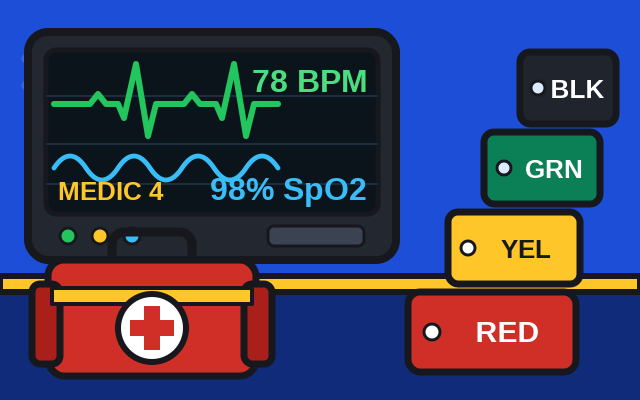
EMT simulator: Run Medic 4: size up scene safety, treat life threats in the right order, read vital signs and snap START triage tags.
The five domains of the NREMT EMT exam
Since April 7, 2025 the NREMT's EMT cognitive exam is built on five domains, with these shares of the exam (NREMT, Examinations Content). Each question here is filed under the domain it practices.
Scene Size-Up and Safety
15-19% of the exam
Here: Gloves first, power lines, chemical clouds, counting patients and calling for more help.
Primary Assessment
39-43% of the exam
Here: Spurting blood, opening the airway, bag-valve-mask breaths, oxygen, shock and cardiac arrest.
Secondary Assessment
5-9% of the exam
Here: The SAMPLE history that follows the primary survey.
Patient Treatment and Transport
20-24% of the exam
Here: Nitroglycerin limits, aspirin, oral glucose only when alert, and epinephrine for anaphylaxis.
Operations
10-14% of the exam
Here: START triage at a mass-casualty incident.
Independent EMT study tips
Every state requires EMTs to be licensed. Most states ask for the National Registry (NREMT) certification after a state-approved EMT course; others use their own exam. Practice the Job is an independent study site and is not affiliated with or endorsed by NREMT.
In scenario questions, watch for order words such as first, immediate or most important. Gloves and scene safety come before touching the patient. In the primary assessment, spurting blood, the airway and breathing are treated as they are found, before any history or vital signs: the NREMT skill sheets count the opposite order as a critical error.
- Rule out any answer outside EMT scope, such as a breathing tube or IV drugs.
- Nothing by mouth to a patient who is not alert or cannot swallow.
- Before nitroglycerin: a systolic over 100 and no PDE-5 drug in the last 48 hours.
- When the neck may be hurt, try the jaw thrust first; if it fails, head tilt and chin lift. An open airway comes first.
Questions people ask
Is this NREMT-style EMT practice test free and independent?
Yes. Every question and explanation is free in your browser with no sign-up. Practice the Job is an independent study site and is not affiliated with or endorsed by NREMT.
Which domains does the NREMT EMT exam cover?
Since April 7, 2025 the NREMT EMT exam has five domains: Scene Size-Up and Safety (15-19% of the exam), Primary Assessment (39-43%), Secondary Assessment (5-9%), Patient Treatment and Transport (20-24%) and Operations (10-14%). This practice test files each of its questions under one of them.
What is the most common mistake on EMT scenario questions?
Getting the order wrong. Gloves and scene safety come first. The primary assessment then finds and treats life threats (spurting blood, airway, breathing, shock) before any history or vital signs, and every answer stays inside EMT scope.
Does passing a practice test certify me as an EMT?
No. Every state requires EMTs to be licensed. You finish a state-approved EMT course, pass the NREMT exams (most states) or an equivalent state exam, and apply for the state license.
Where this comes from
- NREMT, examination content: EMT domains
- NREMT, updated BLS exams launched April 7, 2025
- NREMT skill sheet, Patient Assessment/Management – Medical
- NREMT skill sheet, Patient Assessment/Management – Trauma
- NHTSA, National EMS Scope of Practice Model 2019
- Arizona DHS, Triage, Treatment and Transport Guidelines (from the NASEMSO model)
- HHS REMM, START adult triage
- MedlinePlus, adult CPR
Last changed . Rules change, and states and employers add their own: at work, follow theirs. Found a mistake? How we check, and how to tell us.