START triage practice game: RPM 30-2-Can Do
Build instant recall with this free START triage practice game. Read each casualty's breathing, perfusion and mental status and snap the Red, Yellow, Green or Black tag fast.
START triage
50-year-old lying beside an overturned bus seat, holding his ribs.
Injury: Bruised chest wall.
For practice only. Not affiliated with NREMT and never medical advice or training. In a real emergency call 911.
Use it on a real shift
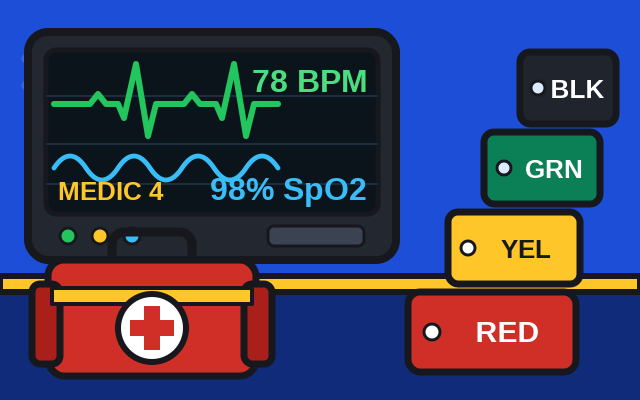
EMT simulator: Run Medic 4: size up scene safety, treat life threats in the right order, read vital signs and snap START triage tags.
START adult triage flowchart: RPM 30-2-Can Do
START stands for Simple Triage and Rapid Treatment. It sorts adult mass casualty patients with a walk test and three checks: Respirations (30), Perfusion (2) and Mental status (Can Do), as HHS REMM draws it.
| Step | What you check | Tag assigned immediately | If clear, go to |
|---|---|---|---|
| 1. Walk | Can the patient walk away from the hazard to a safe zone? | Yes -> GREEN (Minor) | No -> Step 2 (R) |
| 2. R — Respirations | Not breathing? Position the airway once. Otherwise count the breaths against 30 a minute. | Still not breathing -> BLACK (Expectant) Starts breathing after airway -> RED Over 30 a minute -> RED (Immediate) | Under 30 a minute -> Step 3 (P) |
| 3. P — Perfusion | Feel the radial pulse, or time the capillary refill against 2 seconds. | No radial pulse, or capillary refill over 2 seconds -> RED | Radial pulse, or refill under 2 seconds -> Step 4 (M) |
| 4. M — Mental Status | Ask a simple command (“Squeeze my fingers” / “Open your eyes”). | Cannot follow commands -> RED (Immediate) Follows simple commands -> YELLOW (Delayed) | Done — move to next patient |
What the four START triage colors mean
RED — Immediate
Immediate priority. A problem with breathing, perfusion or mental status that needs care within minutes (HHS REMM).
YELLOW — Delayed
Delayed priority. Cannot walk because of serious injuries (such as a broken leg or hip), but breathes under 30 a minute, has a radial pulse or refill under 2 seconds, and obeys commands.
GREEN — Minor
Minor (walking wounded). Able to walk under their own power to the designated collection area for later re-evaluation.
BLACK — Expectant
Expectant. Not breathing even after the airway is positioned once; care goes first to the RED casualties who can be saved.
Questions people ask
What does RPM 30-2-Can Do mean in START triage?
At a mass casualty incident, after the walking patients move to the collection point (Green), check R: breathing over 30 a minute is Red. P: no radial pulse or capillary refill over 2 seconds is Red. M: a patient who does not obey simple commands is Red; one who does is Yellow.
When do you assign a Black tag in START triage?
Only when a patient who cannot walk is not breathing, and still does not breathe after you position the airway once. If they start breathing once the airway is positioned, tag them Red (Immediate).
What is the difference between Red and Yellow tags?
Red (Immediate) means a problem with breathing, perfusion or mental status that needs care within minutes. Yellow (Delayed) means the patient cannot walk, but breathes under 30 a minute, has a radial pulse or refill under 2 seconds, and obeys simple commands.
Is START triage used for children?
START is for adults. For children, many EMS agencies use JumpSTART, a pediatric version of START described by HHS REMM.
Where this comes from
Last changed . Rules change, and states and employers add their own: at work, follow theirs. Found a mistake? How we check, and how to tell us.
More EMT practice
- NREMT-style practice testIndependent EMT exam questions sorted by the five NREMT domains, from scene size-up to operations.
- Normal vital signs chart & quizReference chart for adult and pediatric vitals plus an interactive monitor quiz.
Like this kind of game? See spot-it games and code and memory quizzes.