Cooking temperatures food safety quiz and chart
Lock in commercial kitchen limits with this free cooking temperatures food safety quiz. Match poultry, ground meats, seafood, eggs and holding pans to their FDA Food Code numbers.
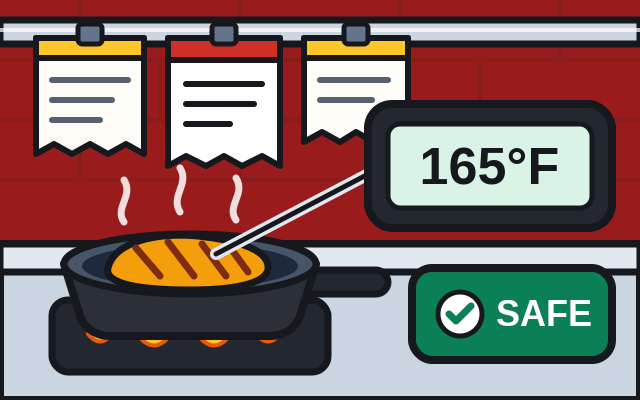
Tap the required commercial kitchen temperature on the digital probe dial:
For practice only. Not affiliated with ServSafe or the National Restaurant Association. Follow your local health department code at work.
Use it on a real shift
Line Cook simulator: Work a commercial kitchen line: probe safe cooking temperatures, stock the walk-in cooler and stop allergen cross-contact.
FDA Food Code 2022 minimum internal temp chart
Commercial restaurants follow the FDA Food Code. Memorize these five numbers — 165°F, 155°F, 145°F, 135°F, and 41°F — and you can probe almost any dish on the line.
| Minimum Internal Temp | Hold Time | Foods Covered (FDA Food Code) |
|---|---|---|
| 165°F (74°C) | Instantaneous (< 1 sec) · Reheating: 15 sec (within 2h) | Whole or ground poultry (chicken, turkey, duck), stuffed meat, fish or pasta, and stuffing containing meat or poultry are instantaneous (§3-401.11). Previously cooked TCS leftovers reheated on a range for hot holding require 165°F for 15 seconds within 2 hours (§3-403.11). |
| 155°F (68°C) | 17 seconds (or 158°F instantaneous) | Ground meats (ground beef burgers, ground pork, raw sausage), mechanically tenderized or injected meats, and raw shell eggs cooked for hot holding on a buffet or steam line (§3-401.11). |
| 145°F (63°C) | 15 seconds | Whole cuts of seafood and fish (salmon, cod, shrimp), whole steaks and chops of beef, pork, veal and lamb, and raw shell eggs cooked to order for immediate service. |
| 135°F (57°C) | Hot holding minimum | Fruits, vegetables, rice, beans and grains cooked for hot holding, commercially processed ready-to-eat foods heated for hot holding, and all hot TCS food held on a steam table. |
| 41°F (5°C) or lower | Cold holding maximum | All cold TCS foods (cut greens, sliced tomatoes, cut melon, milk, deli salads, and raw proteins) in walk-in coolers and refrigerated prep rails. |
Commercial 155°F vs. home 160°F burgers
The home chart at FoodSafety.gov, written for home cooks, lists 160°F for ground meat, with no hold time. In commercial kitchens, FDA Food Code §3-401.11 allows 155°F held for 17 seconds OR 158°F instantaneous (<1 second) on ground meats (and 145°F for 15 seconds on whole cuts). Always verify which code your local health department enforces.
The 41°F to 135°F Danger Zone
Between 41°F and 135°F is the commercial Temperature Danger Zone, where bacteria double rapidly — especially between 70°F and 125°F. Always insert a clean, calibrated thermometer probe into the thickest part of the food away from bone or the skillet bottom to check the true internal temp.
Questions people ask
Why does the FDA Food Code use 155°F for ground beef instead of 160°F?
In commercial kitchens, FDA Food Code §3-401.11 allows ground meats (ground beef, ground pork, sausage) at 155°F held for 17 seconds OR 158°F instantaneous (<1 second). The home chart at FoodSafety.gov, written for home cooks, lists 160°F for ground meat, with no hold time.
What foods must be cooked to 165°F?
Whole and ground poultry (chicken, turkey, duck), stuffed meats, stuffed fish or pasta, and stuffing containing meat or poultry require 165°F (74°C) instantaneous (§3-401.11). Previously cooked TCS leftovers reheated on a range for hot holding require 165°F for 15 seconds within 2 hours (§3-403.11).
What is the internal temperature for eggs in a restaurant?
Raw shell eggs broken and cooked for immediate service must reach 145°F for 15 seconds. Shell eggs cooked for hot holding on a buffet or steam table must reach 155°F for 17 seconds (or 158°F instantaneous).
Where do you probe a burger or chicken breast?
Insert a clean, calibrated stem thermometer into the thickest center of the food — the coldest spot — while avoiding bone, gristle and the hot bottom of the skillet.
Where this comes from
Last changed . Rules change, and states and employers add their own: at work, follow theirs. Found a mistake? How we check, and how to tell us.