Claim denial codes CARC list: lookup and quiz
Look up common claim denial codes and CARC group codes (CO, PR, OA) on an EOB, see whether the balance is billable to the patient, and drill the right fix.
| Code | Meaning | Bill patient? | Billing next step |
|---|---|---|---|
| PR-1 | Deductible amount The part of the allowed amount the plan applied to the patient's deductible. | Yes (PR) | Post the deductible from the remittance and bill the patient (or a second plan, if there is one). |
| PR-2 | Coinsurance amount The patient's percentage share of the allowed amount. | Yes (PR) | Post the coinsurance and send a patient statement (or bill a second plan first). |
| PR-3 | Co-payment amount The fixed co-payment the patient's plan sets for this service. | Yes (PR) | Apply a copay collected at check-in, or bill the unpaid copay to the patient. |
| CO-4 | Modifier inconsistent with procedure The procedure code is inconsistent with the modifier used. | No | Read the chart, correct the modifier on the line, and submit a corrected claim. |
| CO-16 | Missing or invalid information The claim or service lacks information or has a submission or billing error. | No | Read the remark code that comes with it, fix the missing or invalid CMS-1500 box, and submit a corrected claim. |
| OA-18 | Exact duplicate claim Exact duplicate claim or service. X12 allows it only with group OA, except where a state's workers' compensation rules require CO. | No | Check the status of the original claim and close the duplicate. Never resubmit it as a new claim. |
| OA-19 | Work-related injury (workers' comp) A work-related injury or illness, and so the liability of the workers' compensation carrier. | No | Confirm how the injury happened and send the claim to the workers' compensation carrier. |
| OA-22 | Coordination of benefits (other payer) This care may be covered by another payer under coordination of benefits. | No | Confirm with the patient which plan is primary and send the claim to the primary payer first. |
| PR-27 | Expenses after coverage ended Expenses incurred after the patient's coverage ended. | Check first | Check whether the patient had other coverage on the date of service; if not, bill the patient. |
| CO-29 | Timely filing limit expired The time limit for filing the claim has expired. | No | Appeal with proof of when the claim first reached the payer if it was on time; if it was truly late, write it off and never bill the patient. |
| PR-31 | Patient cannot be identified as insured The payer cannot identify the patient as its insured from the details sent. | Check first | Check the member ID, the spelling of the name and the birth date on the insurance card, and resubmit. |
| CO-45 | Charge exceeds allowed amount The charge is above the fee schedule, maximum allowable or contracted fee. | No | Write off the difference between billed and allowed. Never bill an in-network patient for it. |
| CO-49 | Routine or preventive exam not covered A non-covered service because it is a routine or preventive exam, or a test done with one. | No | Check whether the visit was coded as preventive or as a problem visit; correct it if it was miscoded, otherwise write it off. |
| CO-50 | Not medically necessary Non-covered services because the payer does not find them medically necessary. | No | Check the diagnosis linked to the line and appeal with the clinical notes that show the care was needed. |
| CO-55 | Experimental or investigational The payer considers the procedure, treatment or drug experimental or investigational. | No | Read the payer's policy; appeal with clinical evidence, or write it off under the contract. |
| PR-96 | Non-covered charge A charge the patient's plan does not cover. A remark code says more. | Check first | Confirm the service is not covered and check for a signed waiver before billing the patient. |
| CO-97 | Bundled into another service The payment for another service already processed includes this one. | No | Accept the bundled adjustment unless the record shows a truly separate service. Never unbundle or bill the patient. |
| CO-109 | Not covered by this payer This payer does not cover the claim or service; send it to the correct payer. | No | Check the payer on the patient's insurance card and send the claim to the right one. |
| PR-119 | Benefit maximum reached The benefit maximum for this period or occurrence has been reached. | Check first | Confirm the limit with the plan; bill the patient once it is confirmed. |
| CO-140 | Member ID and name do not match The patient's or insured's health ID number and name do not match. | No | Check the name and member ID on the insurance card, correct Box 1a or Box 2, and submit a corrected claim. |
| CO-167 | Diagnosis not covered The diagnosis or diagnoses are not covered. | No | Read the provider's note to confirm the most specific diagnosis; correct it if it was miscoded, otherwise appeal or write it off. |
| CO-197 | Prior authorization absent Precertification, authorization, notification or pre-treatment approval was absent. | No | Send the authorization number if there was one, or ask for a retro-authorization; otherwise write it off. Do not bill the patient. |
| PR-204 | Not covered by the patient's plan This service, equipment or drug is not covered under the patient's current plan. | Check first | Confirm the exclusion and the patient's signed consent, then bill the patient if that is allowed. |
| CO-252 | Attachment or records required An attachment or other documentation is needed to process the claim. | No | Send the notes or reports the payer asks for, attached to the claim's reference number. |
For practice only. Not affiliated with NHA, AAPC or CMS. Do not use this game to file or appeal real medical claims.
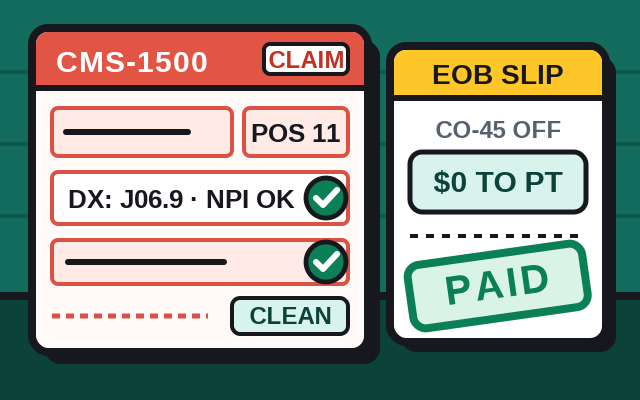
Use it on a real shift
Medical Biller simulator: Scrub CMS-1500 claims, read EOBs, calculate patient responsibility and resolve CARC denials at a medical billing desk.
CARC group codes explained: CO, PR, OA and PI
Every Claim Adjustment Reason Code on an EOB or ERA 835 comes paired with a two-letter Group Code that tells the medical biller who holds financial responsibility.
Contractual Obligation
Holder: The practice
The practice is liable under its contract: it fixes, appeals or writes off a CO amount and never bills the patient for it.
Patient Responsibility
Holder: The patient (or a second plan)
The plan's benefits assign this amount to the patient: deductible, coinsurance, copay or a service the plan does not cover.
Other Adjustment
Holder: Neither
Used only when neither CO nor PR applies. Neither the patient nor the practice can be held responsible for an OA amount.
Payor Initiated Reduction
Holder: The practice, unless an appeal wins
A reduction the payer makes on its own, where no contract covers it. Read the payer's rules before appealing; do not bill the patient.
How to work a medical billing denial queue
In daily medical billing, working denials in a consistent four-step order recovers earned revenue while preventing contract violations.
- 1
Read the Group Code first
Separate CO (Contractual Obligation) from PR (Patient Responsibility) and OA (Other Adjustment). Never send a patient statement for a CO adjustment like CO-45, CO-29 or CO-97.
- 2
Fix administrative errors fast
Denials like CO-16 (missing info) and CO-140 (member ID mismatch) usually pay quickly once you repair the broken CMS-1500 box and file a corrected claim.
- 3
Verify before rebilling or writing off
On OA-18 (duplicate), confirm the original claim's payment status instead of rebilling. On CO-29 (timely filing), check the date the plan first accepted the claim before writing it off.
- 4
Send targeted records on appeals
When appealing CO-50 (medical necessity) or CO-252 (attachment required), send only the minimum clinical documentation needed under HIPAA to prove why care was required.
Questions people ask
What is the difference between CO and PR on a claim denial?
CO stands for Contractual Obligation: the clinic must fix, appeal or write off the amount and cannot bill the patient for it. PR stands for Patient Responsibility: the plan assigned that amount (deductible, coinsurance or copay) to the patient. OA, Other Adjustment, is used when neither applies.
How do you fix a CO-16 denial?
CO-16 means the claim lacks information or has a submission error. Read the accompanying remittance remark code, repair the missing or invalid CMS-1500 box (such as an NPI or member ID), and submit a corrected claim.
Can a clinic bill a patient for CO-29 timely filing?
No. On an in-network claim, CO-29 is a Contractual Obligation. If you have clearinghouse proof showing the claim was filed on time, appeal with that receipt; if the clinic truly missed the deadline, write it off.
What should a biller do when a claim denies as OA-18?
Reason 18 means an exact duplicate claim or service. X12 allows it only with group code OA, except where a state's workers' compensation rules require CO. Check whether the original claim has paid or is still pending, and close the duplicate; never resubmit it to collect twice.
Where this comes from
- X12, Claim Adjustment Reason Codes
- X12, Claim Adjustment Group Codes
- Noridian (Medicare), group codes
- HealthCare.gov, balance billing
Last changed . Rules change, and states and employers add their own: at work, follow theirs. Found a mistake? How we check, and how to tell us.