Free medical billing practice test: CBCS-style
Take a free medical billing practice test with CBCS-style questions and instant answers on CMS-1500 boxes, Place of Service codes, CARC denials and EOB rules. It does not cover CPT or HCPCS coding.
The allowed amount is $500. The patient has $200 left on the deductible and pays 20% coinsurance after it, with no copay and far from the out-of-pocket maximum. How much does the patient owe?
For practice only. Not affiliated with NHA, AAPC or CMS. Do not use this game to file or appeal real medical claims.
Use it on a real shift
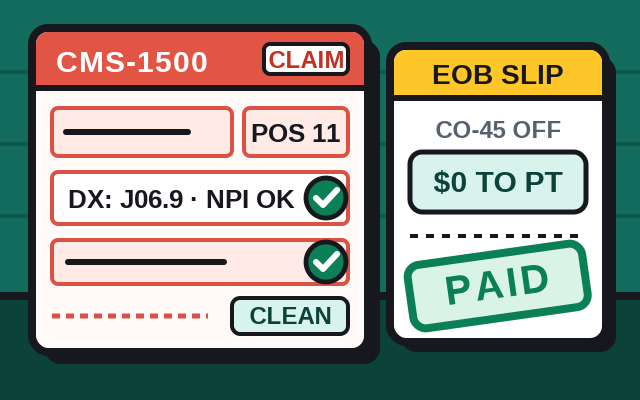
Medical Biller simulator: Scrub CMS-1500 claims, read EOBs, calculate patient responsibility and resolve CARC denials at a medical billing desk.
What this test covers, and what the CBCS adds
NHA's CBCS test plan has 100 scored items: revenue cycle and compliance (15), insurance eligibility (20), coding and coding guidelines (32), and billing and reimbursement (33). This test practices the billing topics below. It does not cover CPT or HCPCS procedure coding, modifiers or E/M levels, which the CBCS tests with the code books open.
CMS-1500 Claim Scrubbing
Verify demographics, Insured's Member ID (Box 1a), Dates of Service (Box 24A), Diagnosis Pointers (Box 24E), and 10-digit Rendering NPIs (Box 24J) before transmitting.
Place of Service & ICD-10-CM
Distinguish CMS Place of Service codes (especially Telehealth POS 10 at home vs. POS 02 away from home, Office 11, Urgent Care 20, Inpatient 21, and ER 23) and spot sex-specific ICD-10-CM edits.
CARC Denial Resolution
Separate Contractual Obligation (CO) denials from Patient Responsibility (PR) balances, fix CO-16 missing info, close OA-18 duplicates, and check the filing dates on CO-29 timely filing.
EOB & Patient Math
Always start from the Allowed Amount, write off CO-45 (Billed minus Allowed), then apply copay, remaining deductible, coinsurance percentage, and Out-of-Pocket Maximum caps.
HIPAA & Billing Compliance
Follow the HIPAA Minimum Necessary standard when attaching clinical notes, respect payer contracts by never billing the patient for a CO adjustment, and avoid unbundling or duplicate billing.
Essential CMS-1500 boxes to memorize
Most first-pass claim rejections trace back to a handful of boxes on the professional CMS-1500 claim form.
| Box | Field | What billers check |
|---|---|---|
| Box 1a | Insured's ID Number | Exact member ID from the insurance card; a typo comes back as reason 140 or 31. |
| Box 2 & 3 | Patient Name, DOB & Sex | Must match eligibility records and align with sex-specific ICD-10-CM diagnosis edits. |
| Box 21 | Diagnosis Codes (ICD-10-CM) | Up to 12 diagnosis codes labeled A through L explaining why the visit was medically necessary. |
| Box 24A | Date(s) of Service | Exact calendar date the visit or service occurred, used for coverage and timely-filing checks. |
| Box 24B | Place of Service (POS) | 2-digit CMS location code such as 11 (Office), 10 (Telehealth Home), 20 (Urgent Care), or 23 (ER). |
| Box 24E | Diagnosis Pointer | Letters (A–L) connecting each billed service line to its supporting ICD-10-CM code in Box 21. |
| Box 24F | Charges | The provider's standard billed fee for each service line before contractual adjustments. |
| Box 24J | Rendering Provider NPI | 10-digit National Provider Identifier of the clinician who performed the care. |
| Box 33 | Billing Provider Info & NPI | Practice name, address, phone, and organizational NPI receiving payer remittance. |
Five compliance traps tested on billing exams
Much of billing is knowing what a biller may not do when an EOB comes back short or denied. Keep these five rules automatic:
- Never bill the patient for CO-45 or CO-29: Billing the difference between billed and allowed charges is balance billing, and the payer contract also forbids billing the patient for a claim the clinic filed past the timely-filing limit.
- Never rebill an OA-18 duplicate: Check the status of the original claim first. Changing a date of service to push a duplicate through makes it a false claim.
- Never unbundle CO-97 services: If a minor item is included in a primary service's global allowance, accept the contractual adjustment unless clinical notes prove a distinct service.
- Apply HIPAA Minimum Necessary: When appealing CO-50 (medical necessity), send only the chart notes relevant to that encounter, not the patient's entire record.
- Use the Birthday Rule for dependent COB: When a child is insured under both parents' commercial plans, the parent whose birthday (month and day) falls earlier in the calendar year is primary.
Questions people ask
Is this medical billing practice test free?
Yes. You can take 10-question or 20-question tests as many times as you like in your browser, with instant explanations and a score by topic.
What does the CBCS exam cover that this test does not?
NHA's CBCS test plan has 100 scored items: revenue cycle and compliance (15), insurance eligibility (20), coding and coding guidelines (32), and billing and reimbursement (33). This test practices billing topics: CMS-1500 boxes, Place of Service, ICD-10-CM edits, CARC denials, EOB math, coordination of benefits and HIPAA. It leaves out the CPT and HCPCS procedure coding, modifiers and E/M levels of the coding area.
Why does this practice test avoid CPT numbers?
CPT procedure codes are copyrighted by the American Medical Association, so this free test leaves procedure coding out. It uses ICD-10-CM and Place of Service codes from CMS and claim adjustment reason codes published by X12.
Does a high score here mean I am ready for the CBCS?
No. A high score shows you know the billing rules this test practices. About a third of the CBCS (32 of 100 scored items) is coding with the CPT, HCPCS and ICD-10-CM code books, which you need to practice as well.
Where this comes from
- NHA, CBCS test plan
- CMS, Place of Service code set
- CMS, ICD-10-CM code resources
- X12, Claim Adjustment Reason Codes
- HealthCare.gov, coinsurance
Last changed . Rules change, and states and employers add their own: at work, follow theirs. Found a mistake? How we check, and how to tell us.