EOB patient responsibility calculator and practice
Use this EOB patient responsibility calculator to work out contractual write-offs, deductible, coinsurance and out-of-pocket maximums step by step, then test yourself.
- 1. CO-45 contractual write-off ($720.00 − $500.00)$220.00
- 2. Visit copay (PR-3)$0.00
- 3. Deductible applied (PR-1)$200.00
- 4. Coinsurance (20% of $300.00)$60.00
- Plan pays ($500.00 allowed − $260.00 patient)$240.00
For practice only. Not affiliated with NHA, AAPC or CMS. Do not use this game to file or appeal real medical claims.
Use it on a real shift
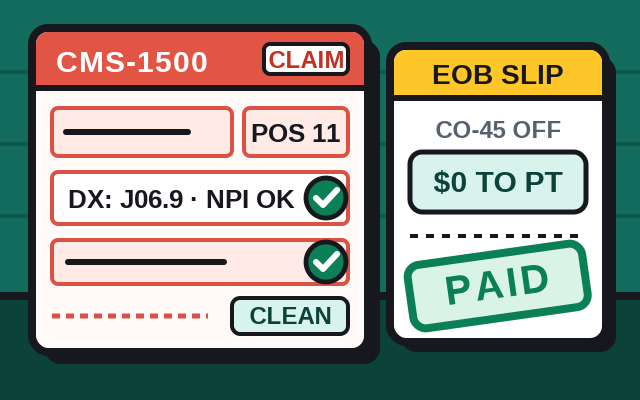
Medical Biller simulator: Scrub CMS-1500 claims, read EOBs, calculate patient responsibility and resolve CARC denials at a medical billing desk.
How to calculate EOB patient responsibility in 5 steps
This calculator works in the five steps below. Starting from the Allowed Amount keeps a patient from being charged for a CO-45 contractual write-off. How a copay and the deductible combine is set by each plan, so check its benefits.
- 1
Write off CO-45
Subtract Allowed Amount from Billed Charge. Write off that difference under CO-45 and never bill it to an in-network patient.
- 2
Apply Copay (PR-3)
This calculator takes a flat visit copay off the Allowed Amount first. HealthCare.gov describes a copay as paid after the deductible, so read the plan's benefits.
- 3
Apply Deductible (PR-1)
Apply the patient's remaining annual deductible up to the remaining Allowed Amount — never above it.
- 4
Compute Coinsurance (PR-2)
Multiply whatever Allowed Amount remains after the deductible by the patient's coinsurance percentage (e.g., 20%).
- 5
Check OOP Maximum
Add copay + deductible + coinsurance, then cap the total at the patient's remaining annual Out-of-Pocket Max.
Worked EOB examples
Deductible plus 20% coinsurance
Most common commercial PPO EOB calculation.
- CO-45 write-off ($720 − $500)$220
- Deductible applied$200
- Coinsurance (20% of $300)$60
Patient owes $260 · Plan pays $240
Flat visit copay only
Standard in-network office visit with a fixed copay.
- CO-45 write-off ($280 − $190)$90
- Visit copay$30
Patient owes $30 · Plan pays $160
Remaining deductible exceeds allowed amount
Patient only pays up to the contracted allowed amount, never the billed charge.
- CO-45 write-off ($440 − $260)$180
- Deductible applied$260
Patient owes $260 · Plan pays $0
Out-of-pocket maximum cap reached
Once remaining OOP max is met, the health plan pays 100% of the rest.
- CO-45 write-off ($1,350 − $1,000)$350
- Coinsurance (20% of $1,000)$200
- Capped at remaining OOP max$120
Patient owes $120 · Plan pays $880
Questions people ask
Does deductible apply to the billed charge or the allowed amount?
On an in-network claim, the deductible applies to the plan's Allowed Amount, never the higher Billed Charge. The difference between Billed and Allowed is written off under CO-45.
Which comes first on an EOB: deductible or coinsurance?
Remaining annual deductible comes first. Once the deductible is met on the allowed amount, the patient's coinsurance percentage applies only to the remaining portion of the allowed amount.
What happens when a patient hits their Out-of-Pocket Maximum?
Once a patient's copays, deductible and coinsurance reach the annual Out-of-Pocket Maximum, their share stops there and the plan pays 100% of the rest of the covered allowed amount.
Does the copay come before or after the deductible?
It depends on the plan. HealthCare.gov describes a copay as a fixed amount you pay for a covered service after you have paid your deductible. This calculator takes the copay off the allowed amount first, so read the plan's benefits for the order it uses.
Why can you never bill the patient for a CO-45 write-off?
In-network providers agree by contract to accept the payer's allowed amount as payment in full. Charging the patient the difference above it is balance billing, which the payer contract forbids.
Where this comes from
- HealthCare.gov, coinsurance
- HealthCare.gov, copayment
- HealthCare.gov, out-of-pocket maximum
- HealthCare.gov, balance billing
- X12, Claim Adjustment Reason Codes
Last changed . Rules change, and states and employers add their own: at work, follow theirs. Found a mistake? How we check, and how to tell us.