Freight rate per mile calculator and load drill
Use this freight rate per mile calculator to see what a load really pays after deadhead miles and truck operating costs, then switch to practice mode to compare live offers.
- Total revenue
- $1,120
- Operating cost (400 mi × $1.85)
- −$740
- Estimated net profit
- +$380
For practice only. Every carrier, broker, load and driver is invented. Always follow current FMCSA regulations and carrier dispatch rules.
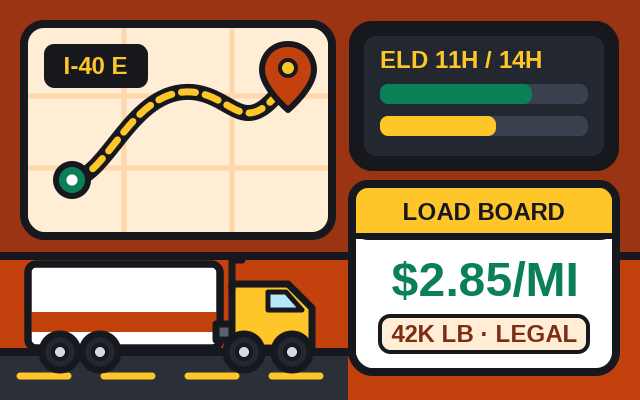
Use it on a real shift
Truck Dispatcher simulator: Run a freight load board: calculate rate per mile with deadhead, enforce 80,000 lb weight limits, and keep drivers legal on FMCSA hours of service.
How trucking math works on a real load board
Sticker pay can fool you. A $1,350 load with 225 empty deadhead miles pays less per mile than a $960 load right across town.
1. Loaded RPM
Linehaul Pay ÷ Loaded Miles
This is the headline number brokers quote on the phone. It ignores the unpaid miles you drive empty to reach the shipper.
2. All-In (True) RPM
Pay ÷ (Loaded + Deadhead)
Every deadhead mile still burns fuel, wear, and driving hours. Dispatchers judge loads on all-in RPM so empty miles never erase the profit.
3. Net Profit Per Load
Total Pay − (Total Miles × Cost/mi)
Subtract fuel, insurance, maintenance, and driver pay per mile across all miles driven to see what the truck actually keeps.
Worked example: spotting a deadhead trap
| Load offer | Total pay | Loaded + Deadhead | Loaded RPM | All-In RPM | Profit @ $1.85/mi |
|---|---|---|---|---|---|
| Offer A (Deadhead trap) | $1,200 | 400 + 200 = 600 mi | $3.00/mi | $2.00/mi | +$90 |
| Offer B (Better load) | $960 | 320 + 40 = 360 mi | $3.00/mi | $2.67/mi | +$294 |
Questions people ask
What is the difference between loaded RPM and all-in RPM?
Loaded RPM divides total pay by loaded miles only. All-in RPM divides total pay by loaded miles plus empty deadhead miles. Dispatchers rely on all-in RPM because empty miles still burn diesel and driving hours.
How do you calculate net profit on a freight load?
Add linehaul pay and any approved accessorials such as detention, then subtract total miles (loaded plus deadhead) multiplied by the truck's operating cost per mile.
Why does a higher-paying load sometimes earn less per mile?
A long empty deadhead to reach the pickup can slash the true rate per mile. A $1,200 load with 400 loaded miles and 200 deadhead miles pays only $2.00/mi all-in, while a $960 load with 320 loaded and 40 deadhead miles pays $2.67/mi all-in.
Where this comes from
- O*NET OnLine, Dispatchers (43-5032.00)
- FHWA, Federal Commercial Truck Size and Weight Laws
- OpenStreetMap directions (OSRM and Valhalla), road miles between the hub cities
Last changed . Rules change, and states and employers add their own: at work, follow theirs. Found a mistake? How we check, and how to tell us.