Trucking dispatch terms list: glossary and quiz
Search this trucking dispatch terms list for plain-English meanings of BOL, deadhead, lumper, detention, TONU and rate con, then flip on quiz mode to lock them in.
- Bill of LadingBOLDocuments
The legal receipt and freight contract listing shipper, receiver, cargo count, weight, and delivery terms.
On the radio: “Make sure the shipper stamps your arrival time on the BOL so we can bill detention.”
- Rate ConfirmationRate ConDocuments
Written contract from a broker or shipper locking in the load pay, pickup and delivery appointments, weight, and special instructions.
On the radio: “Never send a driver to a shipper until you have a signed rate con in hand.”
- Proof of DeliveryPODDocuments
A signed BOL returned by the receiver proving the freight arrived in good condition; required to invoice the broker.
On the radio: “Upload a clear photo of the signed POD right after unloading so accounting gets paid.”
- DeadheadDHRates & Pay
Miles a truck drives completely empty to reach a pickup or reposition to a better freight market.
On the radio: “Always add deadhead miles to loaded miles before calculating your true rate per mile.”
- Rate Per MileRPMRates & Pay
Total freight pay divided by miles driven. Loaded RPM uses loaded miles only; all-in RPM includes deadhead miles.
On the radio: “$1,200 divided by 400 loaded plus 100 deadhead miles equals $2.40 all-in RPM.”
- Linehaul RateRates & Pay
The base charge for moving freight from origin to destination, before fuel surcharges or extra accessorial fees.
On the radio: “The linehaul pays $1,450, and any wait time past two hours is billed separately.”
- DetentionRates & Pay
Extra hourly pay owed to the carrier when a shipper or receiver holds the truck past the free time written in the rate confirmation (often 2 hours).
On the radio: “The driver waited 4 hours at the dock, so bill 2 hours of detention with BOL timestamps.”
- Truck Ordered Not UsedTONURates & Pay
A cancellation fee paid when a broker cancels a confirmed load after the truck was already dispatched or arrived at pickup.
On the radio: “The shipper closed early and cancelled our load after dispatch, so request a $150 TONU.”
- LayoverRates & Pay
A daily flat fee paid when a shipping or receiving delay forces a driver to stay overnight before loading or unloading.
On the radio: “Because the receiver pushed the appointment to tomorrow morning, ask the broker for layover pay.”
- Lumper FeeRates & Pay
A fee charged by third-party dock workers who unload a trailer at grocery warehouses, usually reimbursed by the broker with a receipt.
On the radio: “Keep the lumper receipt and send it with the POD so the broker reimburses the $180 fee.”
- Accessorial ChargeRates & Pay
Any extra charge beyond standard linehaul, such as detention, layover, TONU, tarp pay, or multi-stop fees.
On the radio: “Get every accessorial approved in writing on an updated rate confirmation.”
- Fuel SurchargeFSCRates & Pay
An added per-mile or percentage payment that adjusts freight pricing as diesel fuel prices rise or fall.
On the radio: “The contract rate pays $2.30 linehaul plus a $0.45 per mile fuel surcharge.”
- Dry Van53' VanEquipment
A standard 53-foot enclosed box trailer for non-perishable palletized or boxed freight with no temperature control.
On the radio: “Dry vans haul paper goods, canned food, and retail freight, never frozen meat.”
- ReeferEquipment
A refrigerated, insulated trailer with its own cooling unit for produce, dairy, meat, and frozen cargo.
On the radio: “The BOL says -10°F, so the driver pre-cools the trailer to -10°F before backing into the frozen dock.”
- FlatbedEquipment
An open-deck trailer with no roof or walls used for lumber, steel coils, pipe, and heavy machinery.
On the radio: “Steel coils must go on a flatbed with proper chains and edge protectors.”
- Tare WeightEquipment
The empty weight of the tractor and trailer together, before any cargo. The rigs in this game weigh 33,500 to 37,000 lbs empty.
On the radio: “With a 35,000 lb tare weight, the max legal payload under 80,000 lbs GVW is 45,000 lbs.”
- Gross Vehicle WeightGVWRules & HOS
Total combined weight of tractor, trailer, fuel, driver, and cargo. Federal Interstate maximum is 80,000 lbs without a permit.
On the radio: “A 35,000 lb empty rig plus 47,000 lbs of cargo equals 82,000 lbs GVW, which is illegally overweight.”
- Hours of ServiceHOSRules & HOS
Federal FMCSA safety regulations (49 CFR Part 395) limiting daily and weekly driving and on-duty hours to prevent fatigue.
On the radio: “Check the driver's HOS clocks on the ELD before promising any delivery appointment.”
- Electronic Logging DeviceELDRules & HOS
Hardware connected to a truck's engine that automatically tracks driving time, on-duty hours, and rest breaks.
On the radio: “The ELD shows 6.5 hours left on the 11-hour driving clock and 8 hours on the 14-hour window.”
- 14-Hour Driving WindowRules & HOS
Property-carrying drivers may not drive after the 14th consecutive hour after coming on duty. Off-duty time inside those 14 hours, such as lunch, and on-duty time such as dock waiting do not pause it.
On the radio: “Waiting 3 hours at a dock eats into the 14-hour window even though the truck is parked.”
- 34-Hour RestartRules & HOS
Taking at least 34 consecutive hours off duty to reset the 60-hour/7-day or 70-hour/8-day FMCSA weekly cycle.
On the radio: “After running hard all week, the driver took a 34-hour restart over the weekend for a fresh 70-hour clock.”
- Drop and HookOperations
Dropping an empty or loaded trailer in a yard and hooking immediately to a pre-loaded trailer, avoiding dock wait time.
On the radio: “Drop and hook saves hours on the 14-hour clock compared to waiting for a live load.”
- Live Load / Live UnloadOperations
Staying hooked to the trailer at the dock while warehouse workers load or unload freight pallet by pallet.
On the radio: “Factor at least 2 hours of live load dock time into the driver's 14-hour window.”
- BackhaulOperations
A return load booked to bring a truck back toward its home terminal or main freight corridor instead of running empty.
On the radio: “Even a slightly lower-paying backhaul beats deadheading 400 miles home for zero revenue.”
- HeadhaulOperations
The primary outbound freight lane moving from a high-demand shipping area, usually paying a higher rate per mile.
On the radio: “High headhaul rates out of the Midwest help balance softer return lanes.”
- Check CallOperations
A brief radio, phone, or app status update from the driver confirming arrival, loaded status, reefer temp, or ETA.
On the radio: “Get a loaded check call with the BOL weight and seal number before the driver leaves the shipper.”
- Motor Carrier NumberMC#Documents
An FMCSA operating authority number identifying an interstate for-hire trucking carrier or freight broker.
On the radio: “Verify the broker's MC number and credit status before hauling their freight.”
- Trailer SealOperations
A numbered security lock placed on trailer doors after loading and recorded on the BOL to verify cargo was not tampered with.
On the radio: “The receiver checks that the seal number on the doors matches the number printed on the BOL.”
For practice only. Every carrier, broker, load and driver is invented. Always follow current FMCSA regulations and carrier dispatch rules.
Use it on a real shift
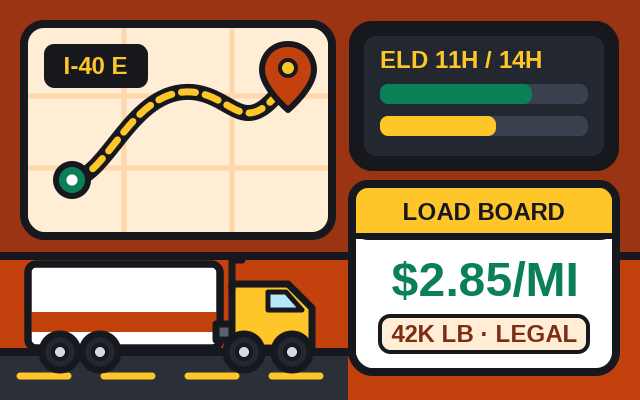
Truck Dispatcher simulator: Run a freight load board: calculate rate per mile with deadhead, enforce 80,000 lb weight limits, and keep drivers legal on FMCSA hours of service.
The freight terms every new dispatcher hears on day one
Trucking has its own shorthand on the radio and on broker rate confirmations. Knowing these three groups saves hours and prevents expensive mistakes.
Documents that get you paid
Before a truck rolls, you lock in a Rate Confirmation (Rate Con). At the shipper, the driver signs the Bill of Lading (BOL). At the receiver, the signed BOL becomes the Proof of Delivery (POD) your carrier needs to invoice the broker.
Accessorial fees to protect margin
When a shipper holds a truck past 2 free hours, bill detention. If a delay runs overnight, ask for layover. If a load cancels after dispatch, request TONU. And always keep the lumper receipt for reimbursement.
Equipment and weight basics
Match dry van, reefer, and flatbed trailers accurately every time, count deadhead miles in your rate per mile, and keep tare weight plus cargo at or under 80,000 lbs GVW.
Questions people ask
What is a BOL in truck dispatching?
BOL stands for Bill of Lading. It is the legal freight receipt and shipping contract listing the shipper, receiver, cargo description, weight, and seal number. Signed at delivery, it becomes the Proof of Delivery (POD) used to get paid.
What does TONU mean on a freight load?
TONU stands for Truck Ordered Not Used. It is a flat cancellation fee paid by a broker or shipper when a confirmed load is cancelled after the truck has already been dispatched or arrived for pickup.
What is the difference between detention and layover?
Detention is hourly pay when a shipper or receiver holds a truck past the free loading or unloading time in the rate confirmation; FMCSA notes that the industry has long counted detention from 2 hours at a facility. Layover is a daily flat fee when a delay forces the driver to wait overnight until the next day.
What is a lumper fee?
A lumper fee is a charge by third-party warehouse crews to unload or sort pallets at grocery and cold-storage docks. Drivers get a lumper receipt so the dispatcher can bill the broker for reimbursement.
Where this comes from
- O*NET OnLine, Dispatchers (43-5032.00)
- FMCSA, Summary of Hours of Service Regulations
- FMCSA, Impact of Driver Detention Time on Safety and Operations (89 FR, Feb. 16, 2024)
Last changed . Rules change, and states and employers add their own: at work, follow theirs. Found a mistake? How we check, and how to tell us.