FMCSA hours of service quiz: HOS rules practice
Drill federal trucking limits with this free FMCSA hours of service quiz. Read realistic driver ELD clocks and decide whether a dispatch is legal under the 11-hour and 14-hour rules.
The driver reaches the receiver with 0.0 hours left on the 14-hour window. The warehouse asks the driver to stay on duty 1 hour for unloading, without moving the truck. Is that legal?
For practice only. Every carrier, broker, load and driver is invented. Always follow current FMCSA regulations and carrier dispatch rules.
Use it on a real shift
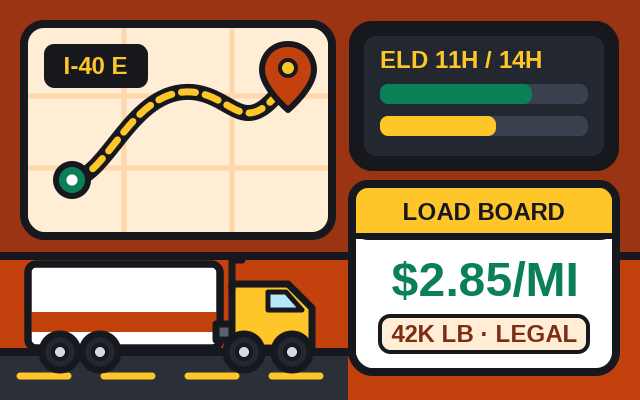
Truck Dispatcher simulator: Run a freight load board: calculate rate per mile with deadhead, enforce 80,000 lb weight limits, and keep drivers legal on FMCSA hours of service.
FMCSA hours of service rules summary (49 CFR Part 395)
Every property-carrying interstate truck driver and dispatcher works inside five federal HOS limits tracked on the ELD logbook.
| FMCSA Rule | Federal Limit | How it works on a shift |
|---|---|---|
| 11-Hour Driving Limit | Max 11 hours driving | Allowed only after 10 consecutive hours off duty. |
| 14-Hour Driving Window | Max 14 consecutive hours | Cannot drive past the 14th consecutive hour after coming on duty. Off-duty breaks or dock delays do NOT extend the 14-hour window. |
| 30-Minute Driving Break | After 8 hours of driving | No driving once 8 hours of driving have passed without 30 consecutive minutes away from driving: off duty, sleeper berth, or on duty not driving such as dock waiting. |
| 60/70-Hour Cycle Limit | 60h in 7 days / 70h in 8 days | May not drive after 60/70 hours on duty in 7/8 consecutive days. A 34-hour consecutive off-duty period restarts the cycle. |
| Off-Duty Reset | 10 consecutive hours off duty | Resets both the 11-hour driving clock and the 14-hour driving window for a fresh shift. |
The number one trap: dock waiting and the 14-hour window
Why the 14-hour clock keeps ticking
New dispatchers often look only at the 11-hour driving bar. If a driver comes on duty at 06:00 for a pre-trip inspection, their 14-hour driving window ends at 20:00 — even if they spend 3 hours parked at a shipper dock or stop for lunch.
Before promising a delivery appointment, always add dock loading time + driving time + any required 30-minute break and compare the sum against the 14-hour window left on the ELD.
How the 30-minute break works
A driver may not drive once 8 hours of driving have passed without at least 30 consecutive minutes away from driving.
That 30-minute break does not have to be off duty: sleeper berth time or on-duty not-driving time (such as waiting at a dock, fueling, or getting loaded) counts and resets the 8-hour driving counter.
Questions people ask
What are the main FMCSA hours of service limits for truck drivers?
Property-carrying interstate drivers may drive at most 11 hours after 10 consecutive hours off duty, may not drive beyond the 14th consecutive hour after coming on duty, must take a 30-minute non-driving break after 8 cumulative hours of driving, and must stay within the 60-hour/7-day or 70-hour/8-day cycle.
Does waiting at a shipper dock pause the 14-hour driving window?
No. Once a driver comes on duty after a 10-hour off-duty break, the 14-hour consecutive window runs straight down. Lunch stops and dock waiting do not extend it (outside narrow sleeper-berth split exceptions).
Does dock loading time count toward the 30-minute break rule?
Yes. Under 49 CFR 395.3, the 30-minute break after 8 cumulative driving hours can be satisfied by any 30 consecutive minutes of non-driving status — off-duty, sleeper berth, or on-duty not driving such as waiting at a dock.
How does a 34-hour restart work on an ELD logbook?
Taking at least 34 consecutive hours off duty resets the driver's 60-hour/7-day or 70-hour/8-day weekly cycle back to zero hours used.
Where this comes from
Last changed . Rules change, and states and employers add their own: at work, follow theirs. Found a mistake? How we check, and how to tell us.
More truck dispatcher practice
- Freight rate per mile calculatorCompare loaded vs all-in RPM with deadhead, fuel and profit, then drill live loads.
- Trucking dispatch termsSearch 28 essential freight terms (BOL, deadhead, lumper, detention, reefer) and quiz yourself.
Like this kind of game? See job test practice and code and memory quizzes.