Debits and credits practice game: normal balances
Build speed with this free debits and credits practice game. Read an account or business transaction, pick Debit or Credit, and see why using the accounting equation.
Scenario: Customer paid cash at the counter.
For practice only. Every business, vendor, invoice and bank statement is invented. This game is not tax or accounting advice.
Use it on a real shift
Bookkeeper simulator: Run a small-business bookkeeping desk: post balanced journal entries, audit accounts payable bills and reconcile bank statements.
Normal balance cheat sheet (DEAD CLIC)
In double-entry bookkeeping, Debit simply means the left column and Credit means the right column. Neither word means good or bad — each account type has a normal balance side that increases it.
| Account Type | Normal Balance | Increase With | Decrease With | Real Examples |
|---|---|---|---|---|
| Asset | Debit | Debit | Credit | Cash, Accounts Receivable, Inventory, Prepaid Insurance, Equipment |
| Expense | Debit | Debit | Credit | Rent Expense, Wages Expense, Utilities Expense, Bank Service Fee |
| Owner's Draws (Contra-Equity) | Debit | Debit | Credit | Owner personal cash withdrawals |
| Liability | Credit | Credit | Debit | Accounts Payable, Unearned Revenue, Notes Payable, Wages Payable |
| Equity (Capital) | Credit | Credit | Debit | Owner's Capital, Retained Earnings |
| Revenue (Income) | Credit | Credit | Debit | Sales Revenue, Service Revenue, Interest Income |
How the accounting equation drives every journal entry
Every balanced journal entry keeps the fundamental accounting equation true: Assets = Liabilities + Equity.
When you expand Equity to show how profits and withdrawals change an owner's stake, you get the expanded accounting equation: Assets + Draws + Expenses = Liabilities + Capital + Revenue, where Capital is the owner's investment. Accounts on the left side of that equals sign (Draws, Expenses and Assets — DEAD) increase with a left-side entry (Debit). Accounts on the right side (Liabilities, Income/Revenue and Capital — CLIC) increase with a right-side entry (Credit).
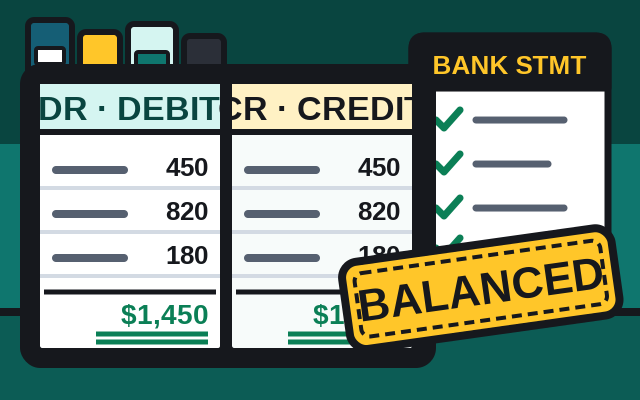
Because every transaction touches at least two accounts, Total Debits must equal Total Credits to the cent on every single journal entry. That rule is what lets a bookkeeper run a trial balance and spot arithmetic posting errors right away.
Cash sale of $385.00
- DR Cash (Asset ↑) — $385.00
- CR Sales Revenue (Revenue ↑) — $385.00
Both sides of the accounting equation rise by $385.00.
Paying $1,100.00 monthly shop rent
- DR Rent Expense (Expense ↑) — $1,100.00
- CR Cash (Asset ↓) — $1,100.00
Cash drops while Rent Expense increases, so Assets + Draws + Expenses still equal Liabilities + Capital + Revenue.
Buying $640.00 inventory on Net 30 credit
- DR Inventory (Asset ↑) — $640.00
- CR Accounts Payable (Liability ↑) — $640.00
You gain an Asset (Inventory) and take on a matching Liability (Accounts Payable).
Collecting $500.00 on an old customer invoice
- DR Cash (Asset ↑) — $500.00
- CR Accounts Receivable (Asset ↓) — $500.00
One Asset turns into another Asset. Revenue was already recorded when the invoice was first sent.
Quick account lookup (25 common small-business accounts)
The business checking account, where the day's cash is deposited.
Money customers owe for invoices already billed.
Goods held in stock to sell to customers.
Insurance paid ahead of time for future months.
Rent paid in advance for upcoming months.
Unused paper, ink and packaging stored on hand.
Long-term tools, ovens, registers and machines.
Business vehicle used for local deliveries.
Unpaid bills owed to suppliers and vendors.
Customer deposits collected before work is done.
Written bank loans and long-term financing.
Employee pay earned but not yet paid out.
Cash or property the owner invests in the business.
Cash the owner withdraws for personal use (reduces equity).
Income earned from selling goods and merchandise.
Income earned from repairs, printing, grooming or labor.
Interest paid by the bank on checking or savings balances.
Monthly rent cost for the shop or kitchen space.
Electricity, water, gas and internet bills.
Everyday supplies used up during the month.
Staff pay earned for shifts worked this period.
Business insurance cost for the current month.
Flyers, local ads and signage promotion costs.
Monthly maintenance and processing charges from the bank.
Fixing equipment, fixtures or shop plumbing.
Questions people ask
What is the fastest way to remember debits and credits?
Use the acronym DEAD CLIC. Debit increases Draws, Expenses, and Assets (DEAD). Credit increases Liabilities, Income/Revenue, and Capital/Equity (CLIC). To decrease any account, use the opposite side.
Does Debit always mean increase and Credit always mean decrease?
No. Debit only means the left column of an account, and Credit means the right column. A Debit increases Assets and Expenses, but a Debit decreases Liabilities, Equity, and Revenue.
Why does Owner's Draws have a Debit normal balance?
Owner's Draws is a contra-equity account. Because taking cash out for personal use reduces Owner's Equity (which has a Credit normal balance), Draws increases on the Debit side.
Why must every journal entry balance?
Double-entry bookkeeping records both sides of every event so the accounting equation (Assets = Liabilities + Equity) stays true at all times. If Total Debits do not equal Total Credits, the trial balance will not balance.
Where this comes from
- OpenStax, Principles of Financial Accounting, 3.1: debits, credits and normal balances
- OpenStax, Principles of Financial Accounting, 3.2: the expanded accounting equation
- AccountingCoach, the owner's drawing account
Last changed . Rules change, and states and employers add their own: at work, follow theirs. Found a mistake? How we check, and how to tell us.
More bookkeeper practice
- Bank reconciliation practiceReconcile bank statements against book cash until both sides match to the cent.
- Bookkeeping practice testPre-employment style bookkeeping test on journals, AP/AR, trial balance and reconciliation.
Like this kind of game? See money and math games and code and memory quizzes.