Free bookkeeping practice test: hiring assessment
Take a free bookkeeping practice test with hiring-assessment questions and instant answers. Covers debits and credits, accounts payable, trial balances and bank reconciliation.
A customer pays $600 upfront for catering to be delivered next month. How should the bookkeeper record the $600 today?
For practice only. Every business, vendor, invoice and bank statement is invented. This game is not tax or accounting advice.
Use it on a real shift
Bookkeeper simulator: Run a small-business bookkeeping desk: post balanced journal entries, audit accounts payable bills and reconcile bank statements.
What this bookkeeper assessment covers
Every employer writes its own skills test. These questions check the work a bookkeeper does every month: record daily transactions accurately and catch errors before financial statements go out.
Debits, credits and the accounting equation
You will classify real accounts (Assets, Liabilities, Equity, Revenue, Expenses) and prove you know which side increases or decreases each one using DEAD CLIC and Assets = Liabilities + Equity.
Accounts payable, accounts receivable and journals
Questions ask how to record credit sales, customer payments, unearned deposits, owner draws, vendor bills and 3-way invoice matching (Purchase Order, Receiving Slip and Vendor Invoice) so the business never overpays.
Trial balance and accrual adjustments
You show that you know what a balanced trial balance can and cannot catch, and how to adjust prepaid expenses and accrued wages at month end.
Bank reconciliation and cash controls
Expect questions sorting deposits in transit, outstanding checks, bank service fees, NSF bounced checks and ledger errors until Adjusted Bank Balance equals Adjusted Book Balance.
Accrual vs. cash basis accounting at a glance
Many pre-employment bookkeeping questions hinge on timing — when revenue or an expense hits the ledger.
| Business Event | Accrual Basis | Cash Basis |
|---|---|---|
| Billed client Net 30 (work finished) | Record Service Revenue now (DR Accounts Receivable / CR Revenue) | Wait until cash payment arrives |
| Customer pays deposit for next month | Record Liability now (DR Cash / CR Unearned Revenue) | Record Revenue when cash is received |
| Paid 6 months of insurance upfront | Record Prepaid Insurance (Asset), expense 1/6 each month | Expense when paid (subject to tax rules) |
| Received vendor utility bill due next month | Record Expense now (DR Utilities Expense / CR Accounts Payable) | Record Expense when the bill is paid |
How to prepare for a bookkeeping skills test
Start by memorizing the DEAD CLIC normal balance table until you do not have to pause before picking Debit or Credit. Then walk through real small-business workflows: recording a credit invoice and later collecting it (without double-counting revenue), running an accounts payable 3-way match, and completing a two-column bank reconciliation from scratch.
Read every question carefully for timing words like on credit, in advance, previously billed, and not yet cleared the bank. Those few words tell a bookkeeper whether Cash, Accounts Receivable, Accounts Payable, Prepaid Assets, or Unearned Revenue belongs on the entry.
Questions people ask
What is usually on a pre-employment bookkeeping assessment?
Employers write their own tests, so they differ. This practice test covers four areas bookkeeping work rests on: normal balances (debits and credits), journal entries for AP and AR, trial balances and accrual adjustments, and a two-column bank reconciliation.
Does a balanced trial balance prove the books have no errors?
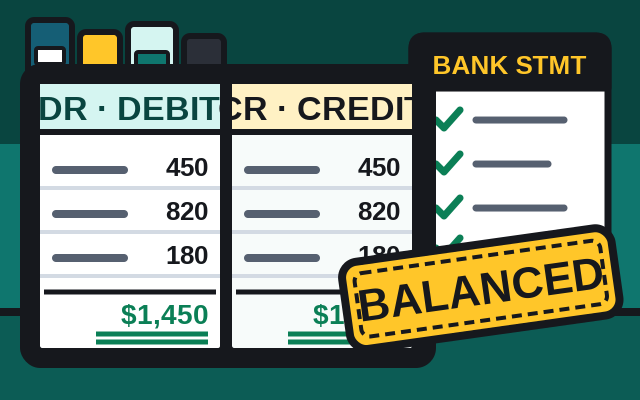
No. A balanced trial balance proves Total Debits equal Total Credits, but it will not catch a transaction posted to the wrong account (such as Rent Expense instead of Utilities Expense) or an entry that was omitted entirely.
What is a 3-way match in accounts payable?
A 3-way match compares three documents before paying a vendor: the Purchase Order (what was approved), the Warehouse Receiving Slip (what actually arrived), and the Vendor Invoice (what the supplier billed), plus checking that the invoice has not already been paid.
How does accrual accounting differ from cash accounting?
Accrual accounting records revenue when it is earned and expenses when they are incurred, even if cash changes hands earlier or later. Cash accounting records income when cash arrives and expenses when cash is paid.
Where this comes from
- OpenStax, Principles of Financial Accounting, 3.1: debits, credits and normal balances
- OpenStax, Principles of Financial Accounting, 4.2: adjusting entries
- OpenStax, Principles of Financial Accounting, 8.6: bank reconciliation
- The Rockefeller University, two-way and three-way matches
- AccountingCoach, the owner's drawing account
- Bureau of Labor Statistics, bookkeeping, accounting, and auditing clerks
Last changed . Rules change, and states and employers add their own: at work, follow theirs. Found a mistake? How we check, and how to tell us.