Bank reconciliation practice: match bank to books
Get hands-on bank reconciliation practice with realistic small-business statements. Place deposits in transit, outstanding checks, bank fees and NSF items until both sides match.
Oct 31 evening flower-shop cash deposit recorded in books, not yet on bank statement.
Check #1104 mailed to Greenfield Nursery — deducted in books, not yet cleared the bank.
$25.00 monthly account fee on the bank statement, not yet entered in our books.
For practice only. Every business, vendor, invoice and bank statement is invented. This game is not tax or accounting advice.
Use it on a real shift
Bookkeeper simulator: Run a small-business bookkeeping desk: post balanced journal entries, audit accounts payable bills and reconcile bank statements.
The two-column bank reconciliation formula
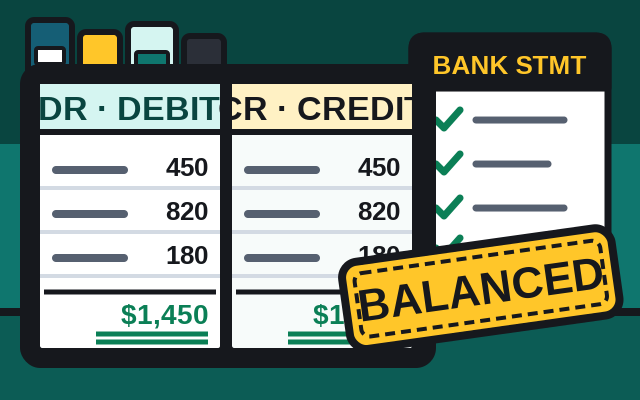
A bank statement and a company's cash ledger almost never show the exact same ending balance on the 31st. Reconciliation proves both records agree on the true cash balance.
Bank Statement Side
Adjust the bank statement for timing items the company already knows about, but the bank has not processed yet:
- Ending Bank Statement Balance
- + Deposits in Transit
- − Outstanding Checks
- = Adjusted Bank Balance
Company Book Cash Side
Adjust your bookkeeping cash ledger for bank notices and recording mistakes you just discovered on the statement:
- Ending Book Cash Balance
- + Interest Earned & EFT Collections
- − Bank Service Fees & NSF Checks
- ± Book Recording Errors
- = Adjusted Book Balance
Where each reconciling item goes (and which ones need a journal entry)
A fast rule for small-business bookkeeping: items placed on the Book side always need a follow-up journal entry so your general ledger matches the true cash balance.
| Reconciling Item | Where It Goes | Journal Entry Needed? | Why |
|---|---|---|---|
| Deposits in transit | + Bank | No journal entry | Already entered in your bookkeeping cash ledger when deposited; the bank just has not posted it before month-end cutoff. |
| Outstanding checks | − Bank | No journal entry | Already subtracted in your books when written; the payee has not cashed the check yet. |
| Monthly bank service fees | − Book | DR Bank Service Fee / CR Cash | The bank already deducted the fee on the monthly statement; update your books to match. |
| NSF (bounced) checks | − Book | DR Accounts Receivable / CR Cash | A customer check bounced for non-sufficient funds. The bank reversed the deposit, so deduct it from Book Cash and re-bill the customer. |
| Bank interest & EFT collections | + Book | DR Cash / CR Interest Income (or AR) | The bank already added funds to your account that have not been recorded in your ledger yet. |
| Book recording errors | + Book or − Book | Correcting journal entry | Errors are fixed on the Book side, by the difference. Book cash too low (a check recorded too high, a deposit recorded too low): add it. Book cash too high (a check recorded too low, a deposit recorded too high): subtract it. |
Why monthly bank reconciliation catches errors early
Reconciling every checking and savings account each month is one of the strongest internal controls in small-business bookkeeping. It immediately spots unauthorized withdrawals, duplicate check clearing, missed EFT deposits, and transposed digits in the cash ledger.
If your Adjusted Bank Balance and Adjusted Book Balance still disagree by a small number, check whether the difference is evenly divisible by 9 — that is a classic sign of a transposition error (such as typing $540 instead of $450). Also check whether an item was added instead of subtracted, which creates a difference equal to twice that item's amount.
Questions people ask
What is the formula for bank reconciliation?
On the Bank side: Ending Bank Balance + Deposits in Transit − Outstanding Checks = Adjusted Bank Balance. On the Book side: Ending Book Cash Balance + Interest/EFT Collections − Bank Service Fees − NSF Checks ± Book Errors = Adjusted Book Balance. You are reconciled when both adjusted balances match to the penny.
Why do deposits in transit go on the Bank side?
Your business already recorded that deposit in its cash ledger when you received the cash or dropped it at the night depository. The bank simply has not posted it yet, so you add it to the Bank Statement side.
How do I record an NSF (bounced) check on a bank reconciliation?
Subtract the NSF check from the Company Book balance (− Book) because the bank already removed those funds from your account. Then post a journal entry debiting Accounts Receivable and crediting Cash so you remember to collect from the customer.
Which reconciling items need a journal entry afterward?
Only items on the Company Book side (bank service fees, interest earned, EFT collections, NSF checks, and book recording errors). Bank-side timing items like deposits in transit and outstanding checks are already in your books.
Where this comes from
- OpenStax, Principles of Financial Accounting, 8.6: bank reconciliation and its journal entries
- U.S. Small Business Administration, manage your business
Last changed . Rules change, and states and employers add their own: at work, follow theirs. Found a mistake? How we check, and how to tell us.