Skip to content

Insurance claims adjuster simulator game

Work a property claims desk: read the declarations page, check coverage, spot padded estimates and red flags, and pay exactly what the policy owes.

A free insurance claims adjuster simulator game online: 8 shifts that start easy, a new one every day, and an endless one. No download, no sign-up, on a phone or a computer.

Clock in: first shift

5 minutes. Every step explained. No sign-up.

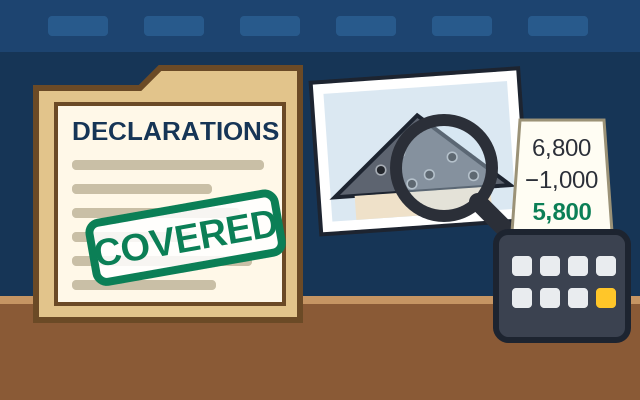
A claims desk with a manila folder, a photo of a hail-damaged roof under a magnifying glass, a green COVERED stamp and an adding machine tape
I'm Marisol Treadwell. I'll show you how it's done.

Your schedule

8 shifts. Each adds one skill and keeps the old ones. Start anywhere; the marked one is next for you.

What you will do

A shift in the insurance claims adjuster simulator
  • Decide coverage

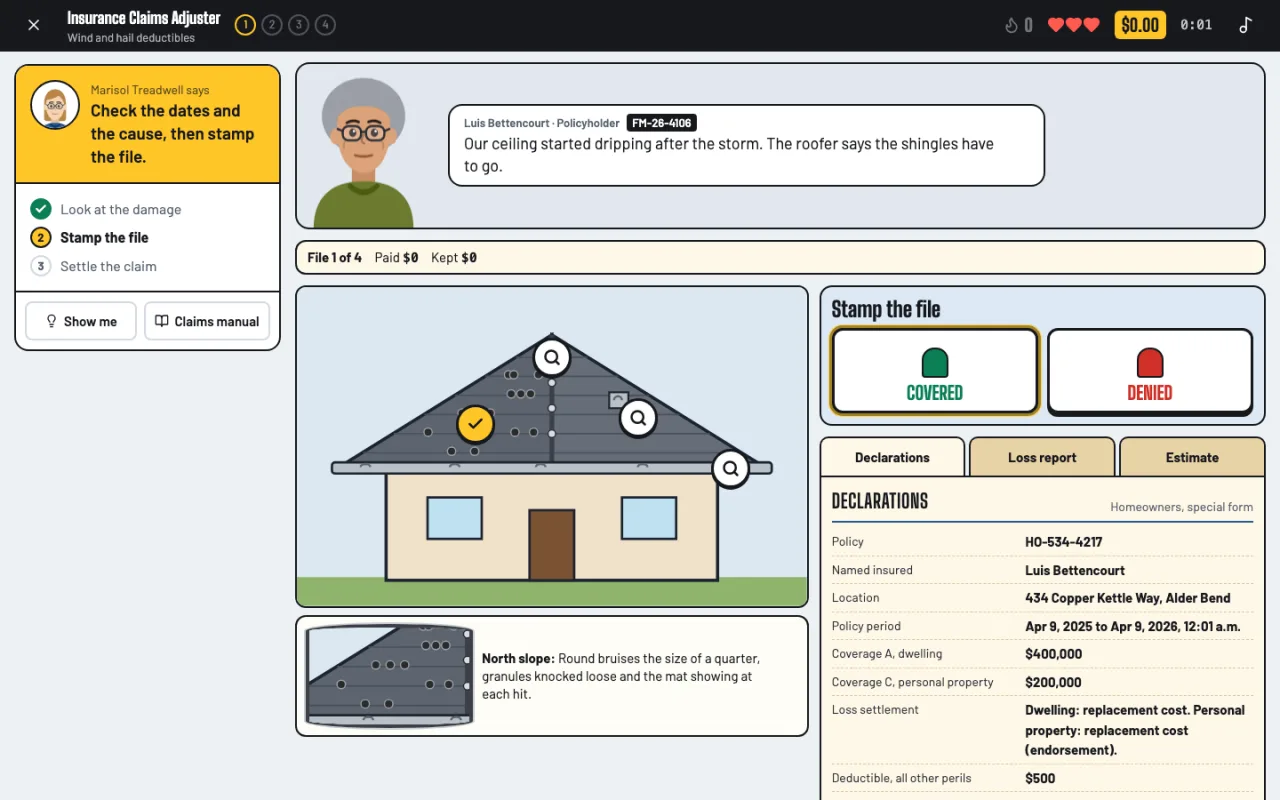
    Check the policy period, look at the photo of the damage and stamp the file covered, denied or for the investigators.

  • Settle the payment

    Take off the deductible, depreciate to actual cash value, and apply the 80% rule or commercial coinsurance on an adding machine.

  • Catch padding and red flags

    Strike estimate lines for damage that is not there, and send files with two or more red flags to the special investigations unit.

  • Answer to your supervisor

    At the end of a shift, see what every decision paid, kept or would have cost.

Insurance Claims Adjuster practice tools

Drills, calculators and reference lists for the skills of this job.

What a claims adjuster does

An insurance claims adjuster decides whether a policy covers a loss and how much it pays. The Bureau of Labor Statistics describes adjusters inspecting property damage, interviewing the claimant and witnesses, determining whether the policy covers the loss, and negotiating the settlement.

On a property claim that means reading the declarations page for the policy period, limits, deductibles and endorsements; comparing what happened with what the policy excludes; checking the contractor's estimate against the damage; and working out the payment.

  • Check that the loss happened inside the policy period
  • Decide whether the cause is covered or excluded, such as flood or wear and tear
  • Compare the estimate with the damage and strike what is not there
  • Apply depreciation, the deductible and any coinsurance penalty
  • Refer files with red flags to the special investigations unit

What a shift at a claims desk is like

Adjusters often work outside the office, inspecting damaged property, and also spend time at a desk reviewing documents, according to the Bureau of Labor Statistics. Inside the office, a desk adjuster works a queue of files: photos from the field, a first notice of loss, a policy and an estimate.

Every decision has a price. Paying a claim the policy does not cover, or paying more than it owes, is money that leaks out of the insurer. Denying a covered claim or paying too little hurts the policyholder. The model act of the National Association of Insurance Commissioners, which state laws follow, lists practices such as refusing to pay claims without a reasonable investigation as unfair when an insurer commits them flagrantly and in conscious disregard of the law, or often enough to be its general business practice.

The math of a property claim

Most claims come down to a few formulas. Actual cash value is replacement cost less depreciation. A homeowners policy pays a dwelling repair at full replacement cost when the house is insured for at least 80% of its rebuilding cost, and otherwise the greater of actual cash value and a share. A commercial policy with coinsurance pays the limit carried divided by the limit it should carry, times the loss. The deductible comes off last.

The game teaches them one at a time, then mixes them, so the right formula has to be picked from the declarations page, not from a hint.

How to become a claims adjuster

According to the Bureau of Labor Statistics, an entry-level adjuster typically needs a high school diploma, and some employers prefer a bachelor's degree or insurance experience. In O*NET's survey, 56% of claims adjusters, examiners and investigators said the job needs a bachelor's degree. Licensing requirements vary by state, and in some states adjusters employed by an insurer do not need a license of their own.

Pay and job outlook

According to O*NET OnLine (13-1031.00), the 2025 median pay for claims adjusters, examiners and investigators was $78,000 a year, or $37.50 an hour, across 376,100 jobs. Employment from 2025 to 2035 is projected to decline by 1% or more, with about 20,900 openings a year.
Insurance Claims Adjuster simulator: questions

Is this insurance claims adjuster simulator free?

Yes. All eight training shifts, the daily claim queue, the endless queue and both calculators run free in your browser, with no account or download.

Does the game follow real insurance rules?

Its formulas come from state insurance departments and an insurer's published claim guide: actual cash value and the 80% rule as the New York Department of Financial Services explains them, deductibles as the Texas Department of Insurance does, and commercial coinsurance as worked in Travelers' guide. Fernhollow Mutual, its policies and its desk rule for red flags are invented, and real policies differ.

What is a declarations page?

It is the summary page of a policy: the named insured, the policy period, the coverage limits, the deductibles and the endorsements. The Texas Department of Insurance notes that a home policy may have separate deductibles for wind and hail.

Why does the game send some files to SIU instead of denying them?

Red flags are facts that call for a closer look, not proof of fraud. Insurers keep special investigation units to look into suspicious claims, and the NAIC model act lists refusing to pay claims without a reasonable investigation among unfair claims practices.

Will this help with a property and casualty license exam?

It practices the claim math those exams ask about: deductibles, actual cash value, the 80% rule and coinsurance, and common homeowners exclusions. It does not cover liability, auto or the insurance law of any one state.

Try another job