Order of draw game: put the tubes in order
An order of draw quiz among our phlebotomy games: put five or six blood tubes in the order CLSI publishes, from the blood culture bottle to the gray top, then check which ones are in place. Every new set mixes the cap colours.
Put the tubes in the order of draw
Arrange the tubes from first drawn to last. Drag a card or use its Earlier and Later buttons, then check.
- Position 1Blood culture bottleblood culture
- Position 2Light blue topsodium citrate
- Position 3Gray topsodium fluoride and potassium oxalate
- Position 4Lavender topEDTA
- Position 5Light green topheparin, with or without gel
- Position 6Red topserum: clot activator or gel
Arrange the tubes, then check your order.
The order of draw (CLSI GP41)
- 1. Blood culture: blood culture bottle
- 2. Sodium citrate: light blue
- 3. Serum: clot activator or gel: red or gold
- 4. Heparin, with or without gel: green or light green
- 5. EDTA: lavender or pink
- 6. Sodium fluoride and potassium oxalate: gray
The cap colours are the examples CLSI gives. Makers and workplaces differ: the workplace's own procedure decides.
Educational cards and fictional intake desk only. No collection procedures, real tests or diagnoses. The shift uses fictional routing codes, not clinical tube categories. Do not use this game to handle real specimens or patients.
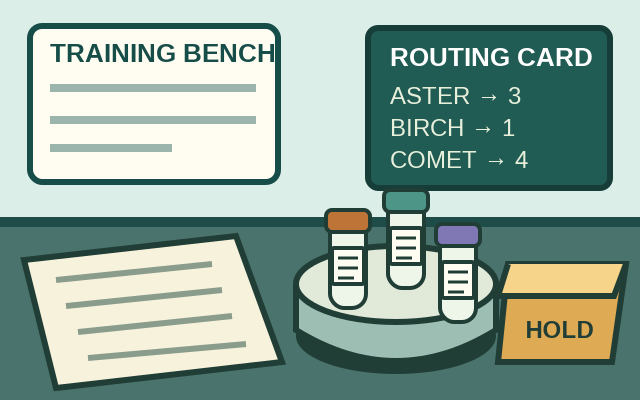
Use it on a real shift
Phlebotomist simulator: Check simulated paper orders, turn the sample rack, apply routing stickers and hold discrepancies.
Why the order of draw matters
When several tubes are filled from one needle, a little of each tube's additive can be carried into the next. The order of draw keeps an additive away from the tubes whose tests it would change. CLSI, the body that writes the laboratory standard (GP41), sorts the tubes by what they hold, not by cap colour: blood cultures first, the fluoride and oxalate tube last.
Cap colours are examples. One additive can come in more than one colour (a serum tube can be red or gold), and makers differ, which is why the cards name what each tube holds. CLSI notes, for example, that a plastic serum tube with a clot activator can upset coagulation tests, so it is not drawn before the citrate tube.
What this game is not
It drills one sequence. It does not teach how to collect blood, which tube a test needs, or a workplace's own rules: those come from the laboratory's procedure, its test directory and supervised training. The phlebotomist shift on this site is a different task: checking labels and paperwork at an accession bench.
Questions people ask
What is the order of draw?
The sequence in which tubes are filled at one blood draw, so that an additive is not carried into a tube whose tests it would change. CLSI lists blood culture, sodium citrate, serum (with clot activator or gel), heparin, EDTA, then sodium fluoride and potassium oxalate.
Why does the game name what each tube holds?
Because the order follows the additive, not the colour. CLSI gives cap colours only as examples: a serum tube can be red or gold, a heparin tube green or light green. A workplace's own procedure decides.
Does this teach blood collection?
No. It drills one sequence. How to collect blood, which tube a test needs and local rules come from the laboratory's procedures and supervised training.
Where this comes from
- CLSI, Order of blood draw tubes and additives (GP41)
- University of Iowa Hospitals and Clinics, Phlebotomy Tubes and Order of Draw
Last changed . Rules change, and states and employers add their own: at work, follow theirs. Found a mistake? How we check, and how to tell us.