Cash drawer balancing practice: rolls and proofing
Master cash drawer balancing practice before closing your first window. Count U.S. currency straps and coin rolls, compare against the ledger and spot over or short amounts.
Realistic closing tills that may be balanced, over or short.
Shift cash ledger
Starting + Cash In − Cash Out = Expected
- Starting teller drawer
- $1,500.00
- + Cash deposits in
- +$745.00
- − Cash withdrawals out
- −$420.00
For practice only. Every bank, person, account and check is invented; the one real number is the routing number the U.S. Treasury prints on its own checks. Follow your bank's policies and federal rules at work.
Use it on a real shift
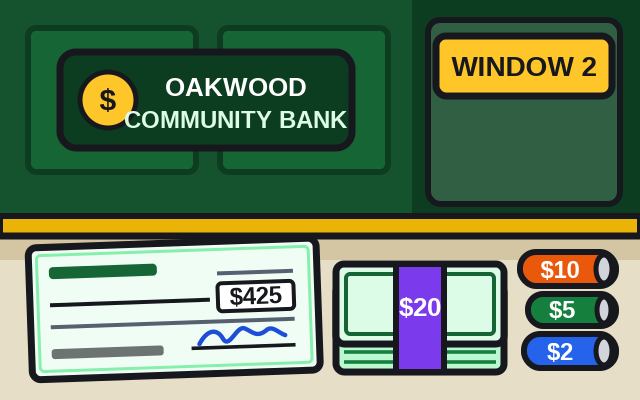
Bank Teller simulator: Run Window 2 at Oakwood Community Bank: count cash and coin rolls, verify checks, apply the $10,000 CTR rule and balance your drawer.
Coin roll colors and U.S. currency straps
U.S. coin wrappers are colored by coin, and a strap of 100 bills carries a band colored to the American Bankers Association's standard, so a teller can count a drawer at a glance.
Coin rolls
| Coin | Wrapper | Coins / roll | Roll value |
|---|---|---|---|
| Quarters | Orange | 40 | $10.00 |
| Dimes | Green | 50 | $5.00 |
| Nickels | Blue | 40 | $2.00 |
| Pennies | Red | 50 | $0.50 |
U.S. currency straps (100 bills)
| Denomination | Band color | Strap value |
|---|---|---|
| $100 | Mustard | $10,000.00 |
| $50 | Brown | $5,000.00 |
| $20 | Violet | $2,000.00 |
| $10 | Yellow | $1,000.00 |
| $5 | Red | $500.00 |
| $1 | Blue | $100.00 |
The teller drawer balancing formula
At the end of every shift, a bank teller proves the physical cash in the drawer against the computer ledger.
1. Expected ending cash
Take your Starting Cash, add all Cash Deposits In, and subtract all Cash Withdrawals Out. That number is what the ledger expects in your teller drawer.
2. Over vs. short
Compare Actual Cash Counted to Expected Cash. More physical cash than expected means your drawer is Over. Less physical cash than expected means your drawer is Short.
3. Troubleshooting a difference
If a difference is divisible by 9 (such as $9, $18 or $27), check your tickets for transposed digits. If it matches a coin roll ($0.50, $2, $5, $10) or single bill ($20, $50), recount that compartment first.
Questions people ask
What are the usual coin roll colors and values?
Red wrappers hold 50 pennies ($0.50), blue wrappers hold 40 nickels ($2.00), green wrappers hold 50 dimes ($5.00), and orange wrappers hold 40 quarters ($10.00).
How do you calculate expected ending cash in a teller drawer?
Use the formula Starting Cash + Cash Deposits In − Cash Withdrawals Out = Expected Ending Cash. Compare your actual counted cash against that expected figure.
What is the difference between over and short when balancing a drawer?
If the physical cash you count is higher than expected ending cash, your drawer is Over. If the physical cash you count is lower than expected ending cash, your drawer is Short.
How many bills are in a standard U.S. currency strap?
A strap holds 100 bills of one kind, and its band is colored to the American Bankers Association's standard: $1 blue ($100), $5 red ($500), $10 yellow ($1,000), $20 violet ($2,000), $50 brown ($5,000) and $100 mustard ($10,000).
Where this comes from
- Federal Reserve, deposit visual reference guide (preparing a strap of 100 notes)
- Wikipedia, currency strap (the ABA band color of each strap)
- Wikipedia, coin wrapper (U.S. roll colors and counts)
- Bureau of Labor Statistics, tellers
- O*NET OnLine, tellers (43-3071.00)
Last changed . Rules change, and states and employers add their own: at work, follow theirs. Found a mistake? How we check, and how to tell us.
More bank teller practice
- Bank teller assessment practiceTimed hiring-style test covering cash counting, number comparison and compliance.
- Check verification practiceFlip mock checks front and back to catch stale dates, mismatches and missing endorsements.
Like this kind of game? See money and math games and code and memory quizzes.